Showing posts with label Book. Show all posts

Tuesday, May 08, 2007

The digging machine


A man is found dead, decapitated by a digging machine.
After such a start, Mio Caro Assassino (My Dear Killer - Tonino Valerii, 1972), had to maintain a certain standard to keep the memorable-images-seeker hooked until its final scene.

Well, what's genuinely striking about this film is not this strong opening scene, but more the typical novel-like structure the rest of the film is built on. Its resolution scene could have been taken out of an Agatha Christie book: inspector Luca Peretti gathers all the suspects in a room and unveils the mysteries of the plot in front of them, to finally reveal the identity of the killer, who is obviously one of them. Isn't this reminiscent of Hercule Poirot's adventures?

Fact is, this giallo has got method. Its opening scene with the digging machine is both misleading, as the rest of the film is not visually as striking (apart from the circular saw murder), and at the same time perfectly consistent with the story structure and the main character.
Because our hero, Peretti, is a digging machine. He will conscentiously and literally dig into the secrets of a bourgeois family where a little girl was killed, explore the dark aspects of a previously aborted investigation led by a private eye (who happens to be the victim of the real digging machine) and relentlessly overcome the obstacles and threats to reach for the truth.

He will do this with a method, which is very unusual in gialli, where most of the time heroes not only don't belong to the police, but also unveil the truth by chance or instinct more than logic.

But the key is: this method is fuelled by a genuine desire of doing good. As a matter of fact, Inspector Luca Peretti appears as one of the very rare truly moral characters of giallo.

A moral giallo? Sounds like an oxymoron.


Find Mio Caro Assassino here (French DVD by Neo Publishing) or there (US DVD by Shriek Show).


Wednesday, February 28, 2007

Images for the masses


A few months ago was published La Dolce Morte, an interesting study of Giallo by Mikel J. Koven. All the more interesting as there's hardly anything serious which was ever published on the genre - long considered a mediocre body of work not deserving of any in-depth analysis by cinema critics.

Which is the angle Koven chose for his book: Giallo was ignored or despised by critics because they were using the same filter to look at these films as for the 'officially artistic' cinema production. This, reckons Koven, was a complete misunderstanding of the initial intentions of this particular cinema, crafted for 'Terza visione' audiences: popular, working-class spectators going to the movies for pure entertainment purposes, very much so like they would consume TV now.

Having set his point of view as Giallo being 'vernacular cinema' that has nothing to do with the art house, Koven then gets into a very detailed analysis of the main themes of the genre, which makes the reader think that paradoxically, he would love Giallo to be recognised as artistic cinema.
Even though Koven's point of view is very relevant and casts a new light on the genre, he can be caught in many occasions using himself a similar method as the one used by traditional cinema critics: analysing the storytelling and the key elements which build gialli's screenplays to serve his main purpose: demonstrate that the genre was not as basic as it could look in the first place. To the point of sometimes over-intellectualising it.

But Giallo is not a cinema of storytelling.
It is a cinema of "memorable images", in the tradition of expressionism, and as such it is closer to painting than litterature. Like these images that struck the killer's disturbed brain in many gialli and triggered their appetite for murder.
The best examples of the superior importance of memorable images over storytelling are "Blood and Black Lace" and "The New York Ripper" which almost reach abstraction in their gratuitous, extremely graphic violence, and where scenario is secondary to the visual effect they're trying to produce.

So we need more books on Giallo.
Books which use semiology as a tool to make these images speak, beyond the scenario.
Books talking about the memorable images. Books made of these memorable images.

Because it's the images that best tell the story of Giallo.


"La Dolce Morte, Vernacular Cinema and the Italian Giallo film", despite showing no image, remains a very interesting first attempt at analysing the genre, that the true Giallo amateur will find here.

Thursday, June 30, 2005

The Giallo amateur's tool


If you're interested in giallo, then you can't miss this book, written by Adrian Luther Smith and published in 1999. Gary Needham, who wrote the very good "An introduction to the Italian giallo", participated in its conception.

It's comprehensively reviewing the films that can be related to the genre, and even more (as I could find quite a few which have more than a distant link with giallo).
It's very resourceful, of course, as it provides you with the right shopping-list of films you must see.

But there are two things which I don't agree with:

One is its subtitle "the definitive guide to Italian sex and horror movies".
Giallo is not a sex or a horror cinema genre. Yes it's talking about fears, yes it's talking about perversion. But it is so restrictive to put it into these two very limited categories. The very reason it's called Giallo is because it is a genre in itself: this is the whole challenge of its definition, which can't be this basic. And this is one of the key purposes of this blog.
In my opinion, Michelangelo Antonioni's "Blow up" is more of a quintessential giallo than Lucio Fulci's "The New York Ripper".

And the second thing is that despite giallo being a highly aesthetic genre, the whole graphic design of this book is very poor, using a lot of cheap & tacky VHS covers from the 80s, when the initial artworks of the posters were so often graphically very rich and elegant, great examples of 60s and 70s design. Even the inside template is very mediocre, cluttered and uninviting to the eye.

All in all, great wine, ugly bottle. Giallo deserves to stand out of the z-movie imagery.

Find the book here at amazon.co.uk.

Monday, June 06, 2005

It comes from the books (2)


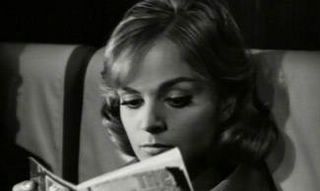
The film which is unanimously considered as the first Giallo opens with a young American lady reading a giallo book on her plane to Rome.
It is Mario Bava's "La ragazza che sapeva troppo" (The girl who knew too much - 1963).

And that detail is so symbolic it can only be a statement : the giallo as a cinema genre was born.

It comes from the books.


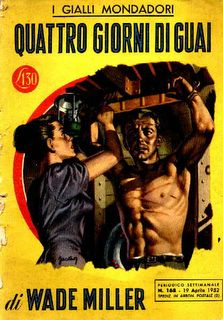
"Giallo" was initially the name of a book collection launched in 1929 by an Italian publisher called Mondadori. They were the Italian version of the more famous American "Pulps" (which gave their name to the famous "Pulp Fiction" by Q. Tarantino) : cheap and easy-to-read thrillers.
Mondadori had chosen yellow ("giallo" in Italian) as the colour code for this collection.

Note the name of the author on this picture : at this time, it had to be an English name to be more credible (even if the real writer was called Giovanni Castellacci or something...).