Showing posts with label Ennio Morricone. Show all posts

Tuesday, March 21, 2006

Take a walk with Gianni


Take a walk with Gianni Ferrio.
Or rather, let him take you for a walk throughout the refined paths of his elegant melodies.

Gianni Ferrio is a much less well-known composer than Morricone, especially in Giallo. Yet his music stands for me as the most delightful surprise of the genre's soundtracks.

It's particularly interesting noticing the differences between both musicians in the composition structure.
Morricone builds his scores on a simple and recurring theme, which somehow works like stones thrown on the water's surface: bouncing and developing circles in waves which grow and vanish, always moving back and forth. An almost fractal musical structure, both very tight and loose at the same time, which made his signature and probably produced the most beautiful themes ever written for films.

If Gianni Ferrio does not have this incredible consistency and strength within his own themes, he is definitely immensely talented for something different, very much ahead of its time: coming up with deliciously crafted pop melodies encapsulated in a mix of jazz and classical structure. This cross-over of musical genres is so natural in his compositions that it comes across effortlessly.

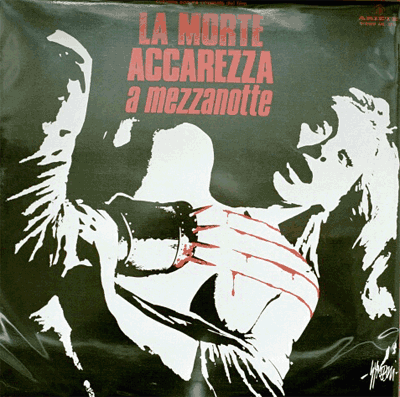
La Morte Accarezza a Mezzanotte is a great example: its theme was built on the main character, Valentina, like a pop-sounding starting point of both the film and the score, which later takes us through more jazzy sounds, nice acid jazz party snapshots and eventually easy listening flavours. It really feels like visiting a house: the general atmosphere remains consistent but depending on the moment and the room you're in, the atmosphere changes and you experience a variety of tunes few composers can compete with.

Another fantastic score is Una Farfalla con le Ali Insanguinate, which manages to mix Tchaikovsky's Concerto no.1 with a jazz tune and makes it sound perfectly elegant and balanced. Again this soundtrack feels like taking a nice walk through the park of an old house which classy owners all have something to hide. Not to forget this very melancholic core theme, reflecting the bitter reality behind a glossy surface depicted by the film. One of these scores which is completely tailor-made for the film yet has a life of its own.

Thanks for the nice walks, dear Signore Ferrio.


Gianni Ferrio's giallo soundtracks and more are available at Movie Grooves.
Saturday, February 11, 2006

On a train


There are different points of view about L'ultimo treno della notte (Night train murders, Aldo Lado - 1975). Some see it as just another "rape-and-revenge" flick, others say it's a copycat of Wes Craven's "Last house on the left" (1972).
In fact, it's a film which leverages a well-known scenaristic frame to convey a political statement about 1970s' Europe.

30 years after, and seen from other cultures, this political dimension could well be not so obvious. However it is this particular element which makes it such a unique film - and the terrible translation of the title into 'Night train murders' totally undermines the initial symbolical meaning of 'The last train of the night'.

It is a social journey between Germany and Italy, surrounded by the shadows of fascism - the German war veterans singing 3rd Reich songs in their cabin -, terrorism of the Red Brigades - the first train stops because of a bomb alert -, cynically questioning the dark side of the Church - the senile bishop glancing at a young priest, and later this obvious physical connexion made by Lado between the bishop seen in the first train and a very unappealing prostitute in the second one -, and above all denouncing the overwhelming power of the upper class, the "Bourgeoisie".

A metaphor where the woman with no name (Macha Méril) epitomises Bourgeoisie, with her veil as a sign of respectability as much as duplicity - and somehow of death.
She is the puppetmaster, cynically manipulating two hooligans - the embodiement of the lower class - to achieve her selfish and vicious goals (raping two young girls on the train). She will later get rid of the two guys by abandoning them to the revenge of the desperate father.
They will end up crawling on the ground like agonising animals.

A fatalistic tale about the ineluctable loss of innocence and its irreversibility.
Once the damage is done, there is no escape: one of the girls dies, the other one has no other choice but to commit suicide.
The implacable build up to a fatal end is very cleverly encapsulated in the idea of the train: a journey you can't deviate from, in a claustrophobic environment.
This is why the real score of this film is the noise of the train, which becomes overwhelming throughout the movie, and sometimes even covers scenes disconnected from the train itself.

In this context, it is interesting to point out that Morricone's score is very minimalist, yet very powerful. A few harmonica notes, highly reminiscent of "Once upon a time in the West", which reinforce the anguish, especially since they're played by one of the two villains.
Strangely enough, music from Morricone scores made for other films can also be heard, as if he was quoting himself: the opening pop track of "Four flies on grey velvet" when the two thugs reach the train station at the beginning of the film, and a reinterpretation of "L'Assoluto Naturale" theme at the end, heard through a radio in the parents' house.

At the end of this trip, there's no justice to be found, no hope to take away ; just the bitter taste of a crude representation of society's cruel games, somehow still relevant today.


L'Ultimo Treno della Notte was one of the two films shown at La Cinémathèque in Paris, during an evening dedicated to Aldo Lado on February the 3rd.

Sunday, December 04, 2005

The sound of confusion


Staging the soundtrack’s main theme within the film scenario itself was one of Lucio Fulci’s very interesting ideas in “A lizard in a woman’s skin”.

The theme, which is once again a wonderful one from Ennio Morricone, perfectly reflects the abyss of confusion in which Carol (Florinda Bolkan) is slowly sinking across the film.
As usual
, the music is used as a recurring pattern. However, with one character it becomes a key element of the scenario: Inspector Corvin (Stanley Baker). Each time he appears in the screenplay, he is shown whistling the theme, in a fashion very reminiscent of Sergio Leone's western (where the characters are strongly identified by their musical theme).

This use of a musical pattern within the scenario is quite unusual in a Giallo. It is very interesting because it builds a link between the two characters on which the film will eventually close: Carol, who can't cope with her inner dilemma, as reflected in the main theme, and the inspector, who from the start, by whistling the very same melody, shows her he has already understood what's happening in her mind.

By this clever use of a simple musical device, Fulci makes it clear that the inspector's deduction technique is a more efficient tool than the psychoanalyst's skills to find the truth and read Carol's twisted mind.
Which means, in this otherwise irrational movie, it surprisingly sounds like the final say is left to rational thinking.


Una lucertola con la pelle di donna's soundtrack can be found here.
More from this blog about this film here and there.

Tuesday, October 11, 2005

Hamilton meets Lynch


Part of the mysterious charm of "What have you done to Solange?" (Massimo Dallamano - 1972) is probably that it is a very elegant voyeur movie.

From the first seconds of the opening credits, where teenage girls are cycling through the countryside in an orange monochrome tone, we understand there is more to these images of innocence than meets the eye. And we want to know and see what it is.

Something terribly wrong floats in a gently erotic atmosphere, as if David Hamilton's and David Lynch's worlds had perfectly merged together to give birth to an evil kind of beauty. This is reinforced by Ennio Morricone's poisonous soundtrack, as sophisticated and aerial as ever.
It is a beauty which is irresistible, so innocent and perverse at the same time, so inaccessible... so close to its own tragic end.

This highly ambiguous shower scene perfectly encapsulates what this great giallo is: a twisted beauty you secretly watch through a keyhole.

More on "Solange" from this blog here.

Monday, July 11, 2005

Music as a film's DNA

In jazz, all great musicians have a unique style that one can recognise just by listening to a few notes of a tune: Miles Davis, Stan Getz, Bill Evans, Wayne Shorter or Herbie Hancock... They've got a signature.


It's the same for Ennio Morricone. His style is absolutely unique and immediately recognisable in a million. Despite him responsible for more than 400 scores in the 60s - 70s, each of them is very faithful to the very idea of the film it was composed for, reflecting it in an effortless manner.

Listen to a score from Morricone: it first sounds very orchestral, very rich and complex. Now listen to it more carefully, you'll soon discover that its backbone is in fact extremely simple: usually 3 or 4 core chromatic notes on which Ennio Morricone builds endless variations, which unveil their amazingly evocative power.
These 3 or 4 key notes manage, as if by magic, to unlock the film's core idea and its singular atmosphere. Images immediately spring to mind. Whether you've seen the movie or not, they open the theatre for you.

Morricone's unique combinations of notes are like the DNA of the films they were composed for.

A concrete example is the role of the music in "Short night of the glass dolls", which I talked about here.
More from this blog about Morricone here and about his favourite female singer Edda dell'Orso there.


For the giallo amateur, the "Mondo Morricone" compilations are an absolute must-have: Mondo Morricone, More Mondo Morricone and Molto Mondo Morricone.

Monday, June 27, 2005

The best score ever.

There's a film which I've never seen, which I'm not sure is really good, which is not a giallo but that I could not help talking about.
It's called "L'Assoluto Naturale" (1969) and features a famous actress of this time : Sylva Koscina. Apparently she spends most of the film not wearing too much clothing - there's an obscure japanese site which shows a vintage fotonovela.


But here are the two great things about it:

There's an Iso Griffo (see picture above), which is one of the most intriguing and rare Italian cars produced - designed by Bertone and engineered by Chevrolet.

And most of all, the score from Ennio Morricone is probably my all time favourite: a simple melody of three notes which epitomises the feeling of nostalgia. It is so evocative I ended up imagining my own personal version of "L'Assoluto Naturale" and turned it into a beautiful film. You can find this chef-d'oeuvre here.

If you've seen this movie or if you have a copy of it, please contact me.

Wednesday, June 22, 2005

Somewhere between life and death

"La corta notte delle bambole di vetro" (Short night of the glass dolls) is a unique giallo. In fact it's nearly not a giallo, according to the definition most people agree on when it comes to talking about this genre : no black-gloves-stabber is to be found here.

It opens on the apparently lifeless body of Gregory Moore, an American journalist, found in a Prague's park. He is actually in catalepsy, but no one seems to notice. As he's transferred to a morgue, he recalls the chain of events which led to his unfortunate situation.

Aldo Lado's great idea is that he applied Moore's condition to every element of the film. It is the whole film which is located somewhere between life and death. And this is what gives it its unique melancholic atmosphere.


One scene that struck me.
In one of the numerous flashbacks, Moore recalls the moments he spent with the beautiful Mira in Prague. They look madly in love with each other, and as they're taking a walk through the city, we follow them into a cimetery where they're playing between the graves, apparently not paying much attention to this sinister place.
Morricone's superb and haunting score, which sounds like being suspended between two worlds, is reinforcing the feeling of despair conveyed by this scene : we know that those two have already stepped on the land of the dead, and that their lives will be sucked away soon.

The score can be found at Movie Grooves, and the film is available from Anchor Bay entertainment.
Also read "Buried alive" on this blog.

Saturday, June 18, 2005

Edda's voice


Ennio Morricone's most amazing soundtracks would not be the same without her. If there's a voice which best encapsulates the desperate beauty of giallo soundtracks, it is Edda Dell'Orso's.

Maybe it's better not to say much about Edda. Her voice is everything. Nothing compares to her delicate and beautiful wordless vocals which are able to turn any melody into a moment of grace.

She sometimes reminds me of Elisabeth Fraser, from early-80's bat-cave band Cocteau Twins : both share this originality of singing without words in a pure, almost virginal way.
Their voices manage to convey superior beauty and infinite sadness at the same time.

What would be the most important moments in gialli if they were not insufflated by these highly emotional and delicate scores?

In gialli, music always leads images. Not the other way around.

A great compilation of Edda Dell'Orso's work can be found on Movie Grooves, here.

Friday, June 03, 2005

My first italian soundtrack

I was 5.
It was a "45 tours" from Ennio Morricone's score for "Le Casse" (AKA Gli Scassinatori or The Burglars - Director : Henri Verneuil). I know it's not a Giallo.
But the score, which builds on a heartbeat rhythm, hooked me and that would be the start of my ear sensitivity to Morricone's haunting melodies.

When many years later I got to see the movie, which is for me a kind of European answer to 'Bullit', I was immediately struck by the ambiguity of the characters (JP Belmondo in the gangster role, and Omar Sharif in the cop's) : the bad guy is never the one you expect. But both of them have got a very stylish attitude.
This is what's nice about European cinema - especially in this 60-70's period. It's got ambiguity and elegance.

Again, the soundtrack is absolutely beautiful.
(And you can find some tracks on the Molto Mondo Morricone compilation)