Showing posts with label Four flies on grey velvet. Show all posts

Monday, March 13, 2006

A tragic clown


Humour comes in short supply in Giallo.
Four flies on grey velvet (Dario Argento, 1971) is a notable exception. If the main character, Michael Brandon, is quite a bland figure, secondary casts are an interesting gallery of tragi-comic characters, sad and grotesque in a unique Italian way.
Take Gianni Arrosio, for example.

Played by Jean-Pierre Marielle, one of the finest French actors, Gianni Arrosio is introduced to us as a homosexual private eye who never solved a case in his life.
Even though Argento's vision of homosexuality is highly stereotypical and sometimes falls into a caricature, Marielle manages to turn it into some kind of weirdness which gives Arrosio an amusing bizarreness.

When Tobias, the rock drummer who's blackmailed for a murder he committed by accident, comes to meet him, Arrosio is busy re-painting his office, wearing a ridiculous blouse. Taken in this embarrassing situation clearly showing he's got nothing much to do, he doesn't seem surprised and very naturally puts down his brush to sit back at his desk, ready to listen to his new client.

"After so many failures, the probability of me solving this case has never been so high", he says as an encouraging start for his investigation, leaving Tobias puzzled. From the very start, Marielle makes his character a tragic clown, both funny and desperate at the same time.

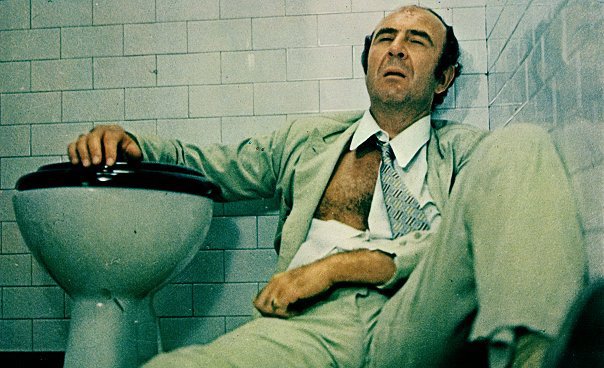
Later in the film, Gianni Arrosio will be the first to identify who's behind the plot. When the blackmailer leads him into a trap in Milan subway's public toilets, and eventually kills him by injecting air through a hypodermic needle in the heart, his last words will be: "I knew I was right". As if he could not believe himself that a success would be possible.

Such an achievement could only condemn him to death.


Jean-Pierre Marielle is an actor whose talent is unique. More about him on Wikipedia in English or in French.

Sunday, February 26, 2006

The staging of the crime


Argento's "animal trilogy", beyond the fact that titles all bear a reference to an animal (bird, cat, flies), has an essential common point: a founding scene which is the pivotal element of the film, giving birth to a twisted mystery, and which is in one way or the other staged. Literally in isolation from the rest of the film.

In "The Bird with the crystal plumage", this scene is obviously the art gallery crime sequence, which is precisely defined and isolated by the frame of the massive glass window from the street and the city life.

A different illustration of the same principle is found in "The cat o'nine tails", where the founding scene is not visual, but audio. There, it is a conversation in a car (again a precise location) which is overheard by a blind man and a little girl as they're passing by.
It is this conversation which holds the key elements of the plot, but of course at the beginning of the film, it is encrypted for us. Just like the art gallery scene in "The bird", which only unfolds its secret at the very end of the movie.

There comes the founding scene of "4 flies on grey velvet" (1971), baroque, picturesque and surreal: One evening, a young rock musician, Tobias, follows into an opera house a man he suspects has been spying him for days.
What better place than an opera house could Argento choose to stage a tragedy?
The moment Tobias enters the building, he symbolically switches to a different world, which boundaries are physically marked by several red velvet curtains he passes through.

Outside is the real world. Inside is a parallel dimension, a vast and empty music hall in which light projectors focus the attention on the stage, where a fight between both men start: the prey becomes the predator as the musician accidentally stabs the mysterious man to death in a reflex of self-defence.
Sole audience of this scene, a third person takes pictures of the crime from the mezzanine. A person wearing a scary smiling mask.

This is the incredible talent of Dario Argento: in an almost exaggerated, maybe typically Italian way, he underlines a scene by making it stand out of the rest of the film, creating what could appear as a completely artificial rupture, yet totally convincing. Like if he was telling us: "Now look very carefully".

Paradoxically, it is when all the details are offered and pointed out that the mystery springs: by indicating where to look, Argento blinds us.


"4 flies on grey velvet" is a much more interesting film than what is usually said about it. Correspondences with David Lynch's work are quite intriguing and visual ideas are really ahead of their time. Check darkdreams.org for a detailed review.
It is however difficult to find a copy of it, as no DVD was released yet. You can still try your luck with second-hand VHS on eBay.

Tuesday, July 19, 2005

Titles 2 (The bestiary)

Italian giallo titles really sound nice to my ears:
L’uccello dalle piume di cristallo
, Una lucertola con la pelle di Donna, Il gatto a nove code, Non si sevizia un paperino, Quattro mosche di velluto grigio, Il gatto dagli occhi di giada, La coda dello Scorpione, Sette scialli di seta gialla.

(The bird with the crystal plumage, A lizard in a woman’s skin, The cat o’nine tails, Don’t torture a duckling, Four flies on grey velvet, The Cat with the Jade Eyes, The case of the scorpion tail, Crimes of the black cat).

Cats, birds, scorpions, lizards, ducks, flies...

In the Middle-Age in Europe, the fear of the Devil being able to sneak into people's bodies led to the idea of the "beast within".

Being possessed, people would lose their judgement and spirituality and would act like animals - led by hunger, envy and rage.
Hence the Devil was often represented as an animal (cat, snake, goat...) or as a hybrid of human and animal.

This shades a new light on the highly symbolic and recurrent presence of animals within the vocabulary of giallo titles, which is a bestiary in itself.

Two interesting books study the relationship between the Devil and animals: "Une histoire du diable", by R. Muchembled (in French) and "The beast within: Animals in the Middle Ages", by J.E. Salisbury.
Read also a previous post about giallo titles.