Showing posts with label Dario Argento. Show all posts

Friday, April 13, 2007

Quotes


I received this morning an email from Semih Tareen, who directed last year a short film called "Yellow". As the name says it is a tribute to Giallo and Mario Bava in particular.

Breaking the editorial and layout rule of this blog (one picture, one point of view, one practical paragraph - never show films), I have decided to share it with you as it is not only very well made, but also a rather entertaining exercise spotting all the "quotes" Semih Tareen put in his film.

Here's what I noticed:
Lighting inspired from Bava's Blood and Black Lace and Argento's Suspiria,
Tree shadow behind windows from the appartment scene in Bava's Girl who knew too much,
Close ups on eyes a la Fulci,
Drawer with gloves and knife from Argento's Bird with the crystal plumage's introducing scene,
Scene with glove on girl's mouth from Bava's Girl who knew too much, Lenzi's Seven blood stained orchids and Argento's Bird with the crystal plumage,
Crime scene music in Goblin's style,
And more surprisingly, checkboard scene and music in typical Thomas Crown Affair's style, by Norman Jewison (soundtrack from Michel Legrand).

There must be some other references I may have missed on, so feel free to add them in the comments section.

Saturday, May 20, 2006

What is the police doing?

Police inspectors at work in Strip Nude for Your Killer.


Institutions falling apart - an underlying topic of Italian genre cinema, especially in Giallo and Poliziesco.

In Giallo, the police is either non-existent, like in Martino/Gastaldi's movies (The Strange Vice of Mrs Wardh, Case of the Scorpion Tail, Your vice is a locked room...), or ridiculously incompetent, like in the caricatural Strip Nude for Your Killer (A. Bianchi - 1975), or even evil and corrupted, like in Aldo Lado's Short Night of the Glass Dolls (1971).
In the best case scenario, it is so inefficient that it needs an outsider's help to do most of the job (like in Dario Argento's animal trilogy).

The figure of the stranger who happens to take the biggest part in the plot's resolution - the "hero by accident", which is already present in the very first giallo La Ragazza che sapeva troppo by Mario Bava - is so recurring that it's like an acknowledgement of a society which has completely lost faith in itself:
Good things can only come from outside of a deeply corrupted community.


More from this blog on Giallo's questioning of Italian institutions here.

Monday, March 13, 2006

A tragic clown


Humour comes in short supply in Giallo.
Four flies on grey velvet (Dario Argento, 1971) is a notable exception. If the main character, Michael Brandon, is quite a bland figure, secondary casts are an interesting gallery of tragi-comic characters, sad and grotesque in a unique Italian way.
Take Gianni Arrosio, for example.

Played by Jean-Pierre Marielle, one of the finest French actors, Gianni Arrosio is introduced to us as a homosexual private eye who never solved a case in his life.
Even though Argento's vision of homosexuality is highly stereotypical and sometimes falls into a caricature, Marielle manages to turn it into some kind of weirdness which gives Arrosio an amusing bizarreness.

When Tobias, the rock drummer who's blackmailed for a murder he committed by accident, comes to meet him, Arrosio is busy re-painting his office, wearing a ridiculous blouse. Taken in this embarrassing situation clearly showing he's got nothing much to do, he doesn't seem surprised and very naturally puts down his brush to sit back at his desk, ready to listen to his new client.

"After so many failures, the probability of me solving this case has never been so high", he says as an encouraging start for his investigation, leaving Tobias puzzled. From the very start, Marielle makes his character a tragic clown, both funny and desperate at the same time.

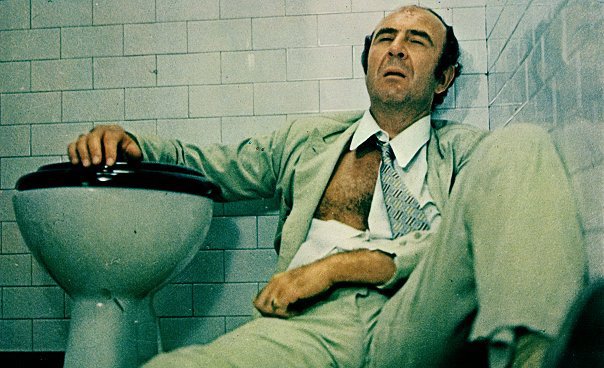
Later in the film, Gianni Arrosio will be the first to identify who's behind the plot. When the blackmailer leads him into a trap in Milan subway's public toilets, and eventually kills him by injecting air through a hypodermic needle in the heart, his last words will be: "I knew I was right". As if he could not believe himself that a success would be possible.

Such an achievement could only condemn him to death.


Jean-Pierre Marielle is an actor whose talent is unique. More about him on Wikipedia in English or in French.

Sunday, February 26, 2006

The staging of the crime


Argento's "animal trilogy", beyond the fact that titles all bear a reference to an animal (bird, cat, flies), has an essential common point: a founding scene which is the pivotal element of the film, giving birth to a twisted mystery, and which is in one way or the other staged. Literally in isolation from the rest of the film.

In "The Bird with the crystal plumage", this scene is obviously the art gallery crime sequence, which is precisely defined and isolated by the frame of the massive glass window from the street and the city life.

A different illustration of the same principle is found in "The cat o'nine tails", where the founding scene is not visual, but audio. There, it is a conversation in a car (again a precise location) which is overheard by a blind man and a little girl as they're passing by.
It is this conversation which holds the key elements of the plot, but of course at the beginning of the film, it is encrypted for us. Just like the art gallery scene in "The bird", which only unfolds its secret at the very end of the movie.

There comes the founding scene of "4 flies on grey velvet" (1971), baroque, picturesque and surreal: One evening, a young rock musician, Tobias, follows into an opera house a man he suspects has been spying him for days.
What better place than an opera house could Argento choose to stage a tragedy?
The moment Tobias enters the building, he symbolically switches to a different world, which boundaries are physically marked by several red velvet curtains he passes through.

Outside is the real world. Inside is a parallel dimension, a vast and empty music hall in which light projectors focus the attention on the stage, where a fight between both men start: the prey becomes the predator as the musician accidentally stabs the mysterious man to death in a reflex of self-defence.
Sole audience of this scene, a third person takes pictures of the crime from the mezzanine. A person wearing a scary smiling mask.

This is the incredible talent of Dario Argento: in an almost exaggerated, maybe typically Italian way, he underlines a scene by making it stand out of the rest of the film, creating what could appear as a completely artificial rupture, yet totally convincing. Like if he was telling us: "Now look very carefully".

Paradoxically, it is when all the details are offered and pointed out that the mystery springs: by indicating where to look, Argento blinds us.


"4 flies on grey velvet" is a much more interesting film than what is usually said about it. Correspondences with David Lynch's work are quite intriguing and visual ideas are really ahead of their time. Check darkdreams.org for a detailed review.
It is however difficult to find a copy of it, as no DVD was released yet. You can still try your luck with second-hand VHS on eBay.

Friday, July 08, 2005

An odd coincidence

I already talked about kinoeye.com, which is a very knowledgeable website when it comes to in-depth analysis of giallo films.
Steven Jay Schneider is a guest-editor for this site and has contributed to insightful articles about Dario Argento.


Donald Cammell - Self Portrait

But, as google made me find out, Steven also wrote in 2001 an article on Donald Cammell, a British director of aesthetical thrillers, which happens to be called: "Killing in Style: The Aestheticization of Violence in Donald Cammell's White of the Eye"

Well that's an odd coincidence of titles.
Having read it, I can tell there's a reason for this: Steven seems to be interested in how Cammell was trying to elevate violence to an art form in his films, which is very close to what I am trying to comment on in gialli. Read on, Steven's point of view is obviously very interesting for the giallo amateur.

Monday, July 04, 2005

Ears can see what eyes don't

Dario Argento often says that "The cat o' nine tails" is one of his least favourite movies.
Well I like it.
One reason for this is that again it is playing with the conventions of the genre:
the eye-witness is a key element of a number of giallos.

And here, the plot starts when blind crosswords-inventor Franco Arno (Karl Malden) overhears a conversation between two people one night. It happens that his "eyes" are those of a little girl who lives with him and describes him the scene he's listening to.

Later on, in a crucial and breathtaking scene, Argento ironically puts Carlo Giordano, a journalist who's partnering with our blind hero in his investigations, in a situation where he's litterally blinded as he's locked inside a tomb and all the action is happening outside, between blind Karl Malden and the murderer. Giordano - and we - can only hear this scene, which makes the suspense reach a peak.

This clever twist on giallo's rules was also present in "The bird with the crystal plumage": what does lead the hero to the murderer? Certainly not what he's seen at the beginning of the film, but a very peculiar noise recorded on a tape...

Two insighful links to check out about "Il gatto a nove code" : kinoeye's article and the images website's.

Tuesday, June 21, 2005

Behind the mirror

Earlier on, I talked about how Mario Bava played with darkness and shadows to instill primal fear in "La ragazza que sapeva troppo".

This was an interesting way of building on the "classic" model of the crime scene : it always happens in the dark. Darkness means fear, danger, violence, crime. In the darkness reality is blurred and obscured, faces are out of sight, threat can come from anywhere. Darkness makes you feel insecure because you can't see and that makes everything possible, even the worst.
Safety is back only when the lights are turned on again, or when the day is back.

In a crucial scene from "The bird with the crystal plumage", Dario Argento turns this classic model upside down.


Look at this picture: this modern art gallery is the crime scene.
Yet there's a frame. There are large glass doors. The room is brightly lit. The dominant colour is white. Every single detail is clear and visible. It actually feels like the only safe place in an empty and dark street at night where Sam Dalmas, the main character, is walking to go home.

The moment after he will be the eye-witness of a brutal attack involving a mysterious man dressed up in black and a beautiful young woman in white in this very gallery.
He will be able to see, but unable to do anything as he's trapped between the two glass doors which have been locked.

This fascinating inversion is at the core of the movie, and will later be referred to in many occasions throughout the scenario, as Sam Dalmas keeps on thinking there was "something wrong about it". How could there be something wrong when everything was apparently so obvious and visible?

Probably because it happened behind the mirror.

You can watch a slideshow of this scene on the excellent darkdreams.org website, dedicated to Dario Argento (in the film reviews section).
More on this film from this blog there.

Tuesday, June 14, 2005

Alfred Argento / Dario Hitchcock

1958


1975


There are connections between Alfred Hitchcock and Dario Argento. These two posters speak for themselves (on top of that I think the Profondo Rosso artwork is simply stunning - even better than the one it was inspired by).

Another connection was the directors' shared taste for making appearances in their own films.
And of course an incredible talent for dramatising violence in a very graphic manner.

The fascinating aesthetics power of violence, again.

Monday, June 06, 2005

Compulsary elements of a Giallo :

Black gloves & knives.


(Taken from the first images of Dario Argento's "Bird with a crystal plummage" - definitely setting the style...)

Anecdote : Dario Argento never managed to get his comedians playing the way he wanted to for this particular scene. The movement of the hands had to be both very precise and very gentle on the knives, almost caressing. He ended up doing it himself.

First attempt for a definition of a Giallo : a film which is a detailed graphic record of the murders perpetrated (often on women) by a mysterious killer wearing black leather gloves and using a blade.

Probably fairly basic, but you have to start somewhere...