Showing posts with label Lucio Fulci. Show all posts

Friday, April 13, 2007

Quotes


I received this morning an email from Semih Tareen, who directed last year a short film called "Yellow". As the name says it is a tribute to Giallo and Mario Bava in particular.

Breaking the editorial and layout rule of this blog (one picture, one point of view, one practical paragraph - never show films), I have decided to share it with you as it is not only very well made, but also a rather entertaining exercise spotting all the "quotes" Semih Tareen put in his film.

Here's what I noticed:
Lighting inspired from Bava's Blood and Black Lace and Argento's Suspiria,
Tree shadow behind windows from the appartment scene in Bava's Girl who knew too much,
Close ups on eyes a la Fulci,
Drawer with gloves and knife from Argento's Bird with the crystal plumage's introducing scene,
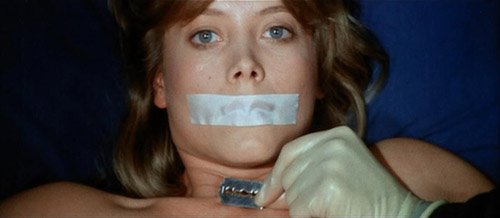
Scene with glove on girl's mouth from Bava's Girl who knew too much, Lenzi's Seven blood stained orchids and Argento's Bird with the crystal plumage,
Crime scene music in Goblin's style,
And more surprisingly, checkboard scene and music in typical Thomas Crown Affair's style, by Norman Jewison (soundtrack from Michel Legrand).

There must be some other references I may have missed on, so feel free to add them in the comments section.

Thursday, March 01, 2007

Into Fulci


"[Fulci] uses the position of the camera to define the moral and emotional weight of his scenes; each shot is a judgement, an act of involvement. [...] Fulci either keeps his distance, shooting from a height, or zooms in as if to point his finger".

I recently came across three articles about Lucio Fulci on the Bad Zero blog, which lay out some highly insightful thoughts on the director's unique style and approach to filming.

Check these two general articles here and here (the latter notably covers "A lizard in a woman's skin") and another one there, which gives an excellent point of view on "Don't torture a duckling" while drawing an interesting comparison with Almodovar's cinema.

Tuesday, February 06, 2007

The ogre's daughter


An antique theatre drama with a modern structure, that is Lucio Fulci's grand oeuvre: 'Beatrice Cenci', released in 1969.
The film opens on the end of the story, as Beatrice Cenci and her family are about to be executed, after having been sentenced to death by the Pope for the murder of their father, Francesco Cenci. This opening scene introduces a structure made of flashbacks, an unusual construct for a film aiming at recreating a classic tragedy from the Italian Renaissance.

Apart from this innovative structure, it looks like Lucio Fulci wanted to come up with a typical historical movie: sophisticated costumes, impressive locations, hundreds of extras, the whole thing feels like a big production with unusually high budgets, aiming at bringing XVIth century Rome back to life.
Fulci probably thought this film should have elevated him to the auteur status. But it did not. Maybe because he was trying a little too hard. Maybe because he thought the Cenci tragedy would allow him to prove he was good at directing actors.
Directing actors is obviously not Fulci's main skill. Thus, the acting comes across as if it was classic theatre, where comedians play in a Shakespearian manner - a little overacted.

Partly because of its flaws, Beatrice Cenci is a very interesting film: it is a twisted historical movie. Behind Fulci's apparent willingness to stay true to the codes of the genre, his obsessions arise, and soon neither the dialogues nor the acting really matter anymore: it's the bodies, again and again. Insisting close-ups on flesh and bodies in pain come back, in typical Fulci's style.
The whole film is a long and painful torture, which pace is set by the construction in flashbacks: it is about a man torturing his family, both psychologically and physically, and then about the Church torturing the same family to make them admit they killed this man (again, Fulci's extremely critical point of view on Religion, as in "Don't torture a duckling"). Inevitably, this leads to a fatal ending - we know it from the very first scene.

Finally, it's a film built on the opposition of two characters: the ogre, Francesco Cenci. Inhuman, corrupted, shameless, cruel, sweating. And his daughter, Beatrice Cenci. Pure, idealistic, faithful, strong, beautiful. She will be the one deciding to kill her father, with the help of her lover.
This is when we will realise that the ogre and her daughter, while seemingly opposite, are in fact very close to each other. Like him, she is merciless.


Beatrice Cenci is Fulci's long-forgotten gem, laying out in 1969 the director's favourite themes of the following decade. Neo Publishing has just released it in DVD.
More on Fulci from this blog here.

Tuesday, January 09, 2007

Renaissance

Portrait of Beatrice Cenci,
by Italian painter Guido Reni (XVIIth century)


Coming soon, Lucio Fulci's "Beatrice Cenci", from 1969. Referred to in Stephen Thrower's "Beyond Terror: Films of Lucio Fulci", as one the director's masterpieces.
Stay tuned.

Sunday, November 05, 2006

Napoli Vice


Fulci again. Luca il contrabbandiere (Contraband), a smugglers' story taking place in Naples, and released in 1980.
Often underrated, this movie is nonetheless a testimony of its time: a time of change. For Italian genre cinema - the beginning of its decline, for Lucio Fulci - from gialli to zombies , and for Italian crime - from cigarettes smuggling to drug traffic. The end of an era, the end of a troubled decade for the country.

Beyond the director's trademark (gore effects, the obsession for body mutilation), there's often a social subtext in Fulci's cinema, as previously demonstrated in "A lizard in a woman's skin" with a point of view on psychedelic culture and drugs in the Swingin' London, and even more brilliantly exposed in "Don't torture a duckling", an impressive allegory on rural Italy's conservatism.

In "Contraband", change is stylistically visible. Photography, just like clothes, have an early 80s touch, disco has definitely invaded the glossy night-clubs' dancefloors, gangsters don't drive Alfa Romeos anymore, but impressive Mercedes, and powerful speedboats allow them to escape coastguards.
We're in Naples, but somehow the whole aesthetics of the film - even though less sophisticated - feels quite close to Michael Mann's TV show "Miami Vice", that would start only four years later.

In "Contraband", ageing gangsters are still watching vintage spaghetti westerns on TV.
Berlusconi's shows will soon take over.

Friday, June 23, 2006

Witch hunt


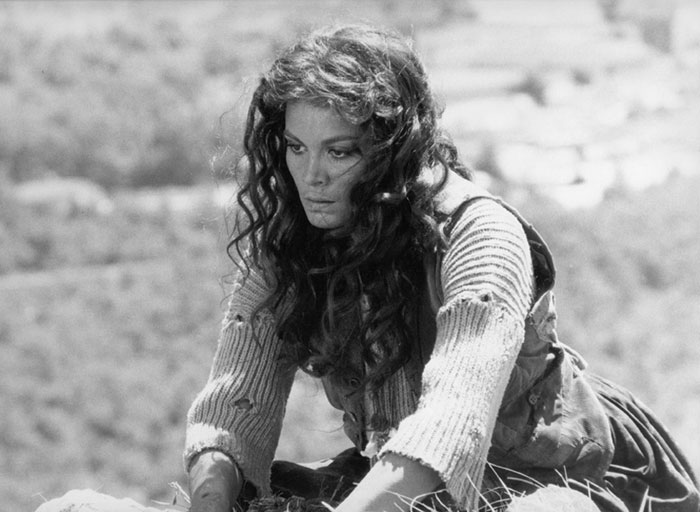
Marciara (Florinda Bolkan) leaves the village's police station in the early morning. She walks through the empty square, amongst the little white houses. She's free.
She had been arrested the day before, suspected of being the killer of three young boys. In fact she did not deny. She told the police she was guilty. She hysterically explained why she wanted to punish them and proudly described how she did black magic to do make the young boys die.
Yes she's the killer, and she's a witch!

Only trouble is the boys were strangled, a more down-to-earth way to die. Therefore Marciara the Witch can only be innocent. The rational thinking of the police sets her free, but also leaves her completely empty: if she has no magic power, then who is she but just a poor mad woman?

Now her mad eyes have turned to a sad and resignated expression, while she walks through the small streets of the village. She is harmless, she won't scare anybody anymore.
Yet the village inhabitants look at her suspiciously - after all, there's always been something wrong with that woman. She is the witch, so it's likely she killed their children.
They look at her as she walks past them. A look that sentences her to death.

On the way to her hideaway in the mountains, out of the village, she suddenly hears a noise. She knows exactly what is happening, and tries to run to hide in the graveyard nearby.
Too late. The villagers immediately catch her. Three of them, armed with wooden sticks and iron chains. They've turned on their car stereo loud, so nobody can hear the witch screaming.

The radio plays "
Quei Giorni Insieme a Te", by Ornella Vanoni, a beautiful song which becomes the soundtrack of her agony.

Bleeding and almost unconscious, she crawls in the dust to reach for the highway, where happy families pass by in their cars, not even seeing her.
There, a few meters from the asphalt, Marciara will die.
The modern world is oblivious to the death of a poor mad woman.


This extremely violent beating scene from Lucio Fulci's "Don't torture a duckling" is one of this masterpiece's highlights, thanks to Florinda Bolkan's stunning talent and Riz Ortoloni's evocative music which both give this moment an incredibly powerful emotional dimension. Get the score here and read more about this film here and there.

Tuesday, June 13, 2006

Kids


Gialli often reflect a point of view on Italy's moral and political crisis of the 70s (Short night of the glass dolls, The bloodstained butterfly...). But it was nearly always made through a very sophisticated vision of the world, the aesthetical treatment moving away from an objective depiction of reality. Giallo is an allegoric cinema genre.

Except for Lucio Fulci's Don't torture a duckling, which could be considered a giallo born out of Neo-Realism.

Beyond the plot, this film has a documentary feel, turning the viewer into a witness of the accelerated modernisation of Italy in the 60s & 70s, depicting the country's evolution through the very ones remaining untouched by change: poor and rural people.
A testimony on a schizophrenic country, stretched out between the extremes of tradition and modernity.
Neo-realist films were clearly about this particular topic after the desolation of WWII: witnesses of the Italian reconstruction, often symbolised by kids (Vittorio de Sica's "Bicycle Thief", Roberto Rossellini's "Open City", amongst many others).

Kids.
In Fulci's film, they clearly embody the link between the old and new Italy.
They are the perpetuation of traditions, under the strict rules of Religion that will ensure this little village living at the foot of a brand new highway will remain untouched.
Yet the kids are irremediably attracted by the promises of the modern world coming from the highway. They are the living connection with this new world, letting temptations and alien cultures in. So much so that they end up becoming a threat to the village community, bringing change and disorder.
In a terrifying reflex of self-preservation, the community chooses to cut this dangerous link out to maintain its integrity.

The community chooses to kill the kids. It's the end of hope.
We are, indeed, in a giallo.


More on Neo-Realism here. And on "Don't Torture a Duckling" from this blog there.

Thursday, June 01, 2006

The transplant


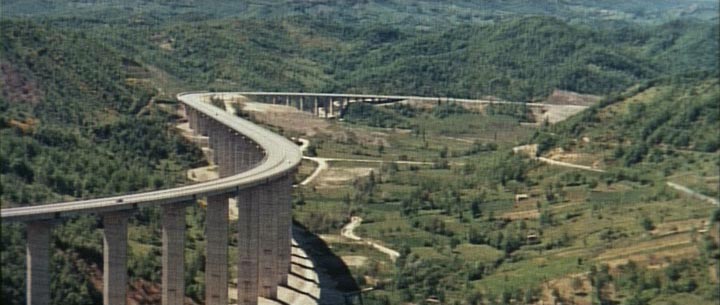
It is a long concrete snake which crawls through a green southern Italian valley, rising above with majesty. A gigantic highway bridge which fluidly carries cars coming from and going to places we will never know of. It is modernity in motion, arrogantly cutting through the past, ignoring those who can't follow its pace.
Down in its shadow, at the foot of the piles, lies a village, stuck in a timewarp. Remote from the movement above.

Two different worlds, living next to each other but completely separated. Yet interactions do occur, and this is the idea Non si sevizia un Paperino (Don't torture a Duckling - Lucio Fulci, 1972) is built on: describing and analysing the violent effects of the intrusion of urbanisation and modernisation in a conservative community.
This is why, contrary to what's being often said, this film is not a rural giallo. Giallo is a quintessentially contemporary and urban genre, and this one is no exception.

In fact, "Non sevizia..." can be considered a detailed report of the reactions of a body rejecting a transplant.

An emblematic symptom of the rejection: Patrizia (Barbara Bouchet). She is the girl who came from the city through the highway, driving a powerful Iso Lele. She lives in a house at the entrance of the village. Her home remains outside of the community though, both geographically and architecturally (a futuristic building in complete contrast with the traditional little white houses). To escape from the suffocating atmosphere of the village which ostracises her, she sometimes goes back to her natural element, the highway, and drives for hours for the sake of driving. Movement against immobility.
She also actively tries to convert the most permeable elements of the community to her libertarian lifestyle, by sexually teasing the young boys of the village.

Temptation is coming from outside. The same teenage boys can't help being intrigued by the regular visit of other outsiders : prostitutes coming from the city to give some nice time to a few workmen.
Temptation is a threat to the community; it jeopardises its future by corrupting youth and detracting them from traditions. It detracts them from the most important: religion.
Temptation implies change, when the main aspiration of this traditional land is to maintain a status quo.

So when the young boys start being murdered one after the other, the whole community stands as one, pointing at those who are considered outsiders: the village idiot, the sleazy city girl Patrizia and a poor mad woman considered a witch, Martiara (Florinda Bolkan).

But the death of the young boys is the brutal and obvious symptom of the village's rejection of the modern world: it's in fact from the deep heart of the community that the sacrifice of "corrupt sprouts" was perpetrated.


Don't Torture a Duckling is probably one of the best gialli ever made, and certainly a demonstration of Lucio Fulci's underestimated talent. It also ties back to the director's obsessions about the body, which he explored in most of his films. More on this theme from this blog here.

Monday, April 17, 2006

Like porn


1982. New York has one of the highest criminality rates of the cities of the world. It epitomises more than any other place the modern Babylon.

1982. Giallo's golden years are far behind. In fact the genre has slowly died in the second half of the 70's, clearing the ground for new 'filones' going even further in the visual representation of violence: the most well-known being the zombies and cannibal genres.
The 'after-giallo' Italian cinema is somewhat a desperate and vain race to reach new heights in shocking audiences, against the ineluctable rise of television.

1982. Lucio Fulci's "New York Ripper" is released and soon becomes famous because of the multiple problems the film encounters with censorship boards in most countries.
Nearly 25 years after, this infamous shocker is still widely debated: a masterpiece or a rip-off? a giallo or a slasher? Should the killer have a Donald Duck voice or shouldn't he?

The anti-aesthetical core principle of "The New York Ripper" - the raw photography, the run-down locations, the miserable characters... - makes this film philosophically incompatible with Giallo.
At the same time, the complete absence of any puritanistic or moral subtext which is slasher's trademark doesn't allow to affiliate the film to this typically American genre.

It's hard to classify "the Ripper". It is so cynical and nihilistic it is almost an experimental object.

In fact, it could be compared with porn as it uses a similar parasitic approach: diverting a rather classic and well-coded cinema style to use it to its own advantage. When porn leverages any stereotypical scenaristic frame as a pretext to fit in as many porn scenes as possible, Fulci hijacks the early 80s American cop film codes and structure to stuff it with ultra-violent (and sometimes almost pornographic) sequences.

This method makes the film both very flat and very paroxystic at the same time. Flat because the scenario is incredibly predictable, linear and, at the end of the day, banal as it is a stereotypical American cop movie, of which Fulci has respected all the codes, including the cheesy score. Paroxystic because this banality is meticulously dynamited from the inside by the regular occurence of voyeuristic and disturbing peaks of violence. Hence an overall feeling of heterogeneity.

In its Italian DVD edition, "The Ripper's" bonuses consist in all the murder scenes in their uncut versions. After watching everything, you get this odd feeling that these bonuses, the murder scenes seen in isolation, embody in fact the purest version of the film. They don't need any scenaristic frame around them to work efficiently. They are its 'raison d'être'. As if Fulci, in an afterthought, had been forced to find a scenario to wrap these scenes in order to be able to produce the movie.
Again, just like porn.

That does not solve the question of the killer talking with a Donald Duck voice, a detail considered original by some, grotesque by others. What's for sure is that it is on behalf of Fulci an intentional disrespect for the rules of the American cop movie: killers don't have a ridiculous voice like Donald Duck's. But what if it was an ironic statement on US subculture?

Yes the world can also be terrorised by Disney's creatures.


"Lo squartatore di New York" is widely available in dvd (US/IT/FR) and its 80s funk influenced score can be found here.

Sunday, December 04, 2005

The sound of confusion


Staging the soundtrack’s main theme within the film scenario itself was one of Lucio Fulci’s very interesting ideas in “A lizard in a woman’s skin”.

The theme, which is once again a wonderful one from Ennio Morricone, perfectly reflects the abyss of confusion in which Carol (Florinda Bolkan) is slowly sinking across the film.
As usual
, the music is used as a recurring pattern. However, with one character it becomes a key element of the scenario: Inspector Corvin (Stanley Baker). Each time he appears in the screenplay, he is shown whistling the theme, in a fashion very reminiscent of Sergio Leone's western (where the characters are strongly identified by their musical theme).

This use of a musical pattern within the scenario is quite unusual in a Giallo. It is very interesting because it builds a link between the two characters on which the film will eventually close: Carol, who can't cope with her inner dilemma, as reflected in the main theme, and the inspector, who from the start, by whistling the very same melody, shows her he has already understood what's happening in her mind.

By this clever use of a simple musical device, Fulci makes it clear that the inspector's deduction technique is a more efficient tool than the psychoanalyst's skills to find the truth and read Carol's twisted mind.
Which means, in this otherwise irrational movie, it surprisingly sounds like the final say is left to rational thinking.


Una lucertola con la pelle di donna's soundtrack can be found here.
More from this blog about this film here and there.

Tuesday, November 29, 2005

Scars


"What are you doing?


- Painting."

When Fulci decides, in "A lizard in a woman's skin", to express his own vision of what painting is, unsurprisingly it ties back to his peculiar obsessions.

The brush becomes a knife.
The knife is plunged into red paint.
It is then thrown onto a white canvas.
When it hits the surface it looks like the canvas is wounded: it's bleeding.

What could look like action-painting is in fact the oldest form of body art: scarification.

Friday, November 25, 2005

Fulci's inner geography

"La lucertola con la pelle di donna" (A lizard in a woman's skin - Lucio Fulci, 1971) is not a giallo.
It's a documentary on Fulci's twisted mind. Actually, a dive into both his mind and his body.

The early years spent by the director as a medical student left strong marks. The fascination for the body as an experimental object went to define Fulci's whole work.
And there's here more than a fair share of this obsession. From close ups on the knife striking the chest during the initial murder scene to the infamous eviscerated dogs sequence, of course Fulci's trademark is here. Physically. Viscerally.

But the body's inside is also very present on a symbolic level: tunnels, corridors, doors opening on dark rooms, spiral staircases draw the complex map of a threatening and surreal labyrinth Carol (Florinda Bolkan) gets trapped in across the film, where imagination and reality end up melting together.
The church scene for example, where Carol is chased by the hippy: the underground hide-and-seek game, where they're running across dark tunnels and overlapping arches, as if they were in a parallel dimension. And the massive church organ where Carol hides next, only to be discovered when the giant pipes start playing by accident, creating a scary symphony as she tries to escape the machinery.

Organs, pipes, underground tunnels and arches, the inner geography of a twisted body. And soul.

Lucio Fulci is a genre of its own. Read more here.