Showing posts with label Modernity. Show all posts

Saturday, January 13, 2007

Giallo is not gothic


Nothing thrills like a good old story of mysterious castles, baroque decorum, ambiguous ancestors, ghostly silhouettes and centuries-old curses on noble families. So much so that worldwide litterature as well as cinema have seen a proliferation of these stories. That we could categorize, even if it is a little of a shortcut, as embodying the Gothic genre.

In Italian genre cinema, if gothic all'italiana had its highlights - La Maschera del Demonio (Black Sunday), shot by Mario Bava in 1960 is definitely one of them -, there are also a number of counter-examples. Actually, the same Bava would return years later, in 1972, with a much less impressive take on gothic with a contemporary flavour: Gli orrori del castello di Norimberga (Baron Blood).

Because Italian genres, or should we say filone, tend to feed one another, most of the time in extremely interesting ways, it could only happen that Giallo would be at some point mixed with Gothic.
Antonio Margheriti's La Morte Negli Occhi del Gatto (Seven deaths in the cat's eye, 1973) and Emilio Miraglia's two gothic gialli La Notte Che Evelyn Uscì Dalla Tomba (The Night Evelyne Came Out of the Grave, 1971) and La Dama Rossa Uccide Sette Volte (The Red Queen Kills Seven Times, 1972) are just a few examples of this attempt at mixing two lucrative filone.
And probably amongst the less interesting gialli ever made.

Like oil and water, gothic and giallo seem to be utterly unable to mix.
Of course these three films can be noticeable by their photography (but in this particular cinema where aesthetics was more important than anything else, great photography was a given). Yet they consistently fail in maintaining any integrity throughout the storytelling. Even visually, they struggle to reconcile two opposites: the contemporary style of giallo and the baroque of gothic.
As a result, they are unconvincing and quite boring to watch.

Unlike other filone, there seems to be a fundamental contradiction between both genres. Whereas Gothic appeals to centuries-old tales and supernatural to trigger fear, Giallo is extremely contemporary by essence. It is born out of vast concrete cities, of their anonymity, of psychologic disorders, of human perversions. Giallo is all but supernatural. At the contrary, it is rooted in real, daily life.

Giallo is Evil next door. Please get rid of the castle.


If you're still curious to watch them, these films can be found at Blue Underground and NoShame films. Also read Michael Mackenzie's reviews here and there.

Thursday, October 12, 2006

Early Marketing Trick


When they have a serious explanation, Edwige Fenech & George Hilton pour themselves a glass of it.
Susan Scott enjoys it with a cigarette, in her cosy boudoir.
From time to time, Luc Merenda gets some.
Franco Nero likes it so much he drinks it while driving.
Anita Strindberg indulges on it with Florinda Bolkan, during a wild party.
Not to mention Jean Sorel, who was spotted with a bottle in his flat.

Yes, J&B is the official Giallo drink.
Which shows that product placement in movies is not a recent idea.

J&B's Italian marketing director was certainly a man of taste, yet image cannot change reality: even with the glamour of Italian genre cinema, it remains a terrible whisky.

Tuesday, June 13, 2006

Kids


Gialli often reflect a point of view on Italy's moral and political crisis of the 70s (Short night of the glass dolls, The bloodstained butterfly...). But it was nearly always made through a very sophisticated vision of the world, the aesthetical treatment moving away from an objective depiction of reality. Giallo is an allegoric cinema genre.

Except for Lucio Fulci's Don't torture a duckling, which could be considered a giallo born out of Neo-Realism.

Beyond the plot, this film has a documentary feel, turning the viewer into a witness of the accelerated modernisation of Italy in the 60s & 70s, depicting the country's evolution through the very ones remaining untouched by change: poor and rural people.
A testimony on a schizophrenic country, stretched out between the extremes of tradition and modernity.
Neo-realist films were clearly about this particular topic after the desolation of WWII: witnesses of the Italian reconstruction, often symbolised by kids (Vittorio de Sica's "Bicycle Thief", Roberto Rossellini's "Open City", amongst many others).

Kids.
In Fulci's film, they clearly embody the link between the old and new Italy.
They are the perpetuation of traditions, under the strict rules of Religion that will ensure this little village living at the foot of a brand new highway will remain untouched.
Yet the kids are irremediably attracted by the promises of the modern world coming from the highway. They are the living connection with this new world, letting temptations and alien cultures in. So much so that they end up becoming a threat to the village community, bringing change and disorder.
In a terrifying reflex of self-preservation, the community chooses to cut this dangerous link out to maintain its integrity.

The community chooses to kill the kids. It's the end of hope.
We are, indeed, in a giallo.


More on Neo-Realism here. And on "Don't Torture a Duckling" from this blog there.

Thursday, June 01, 2006

The transplant


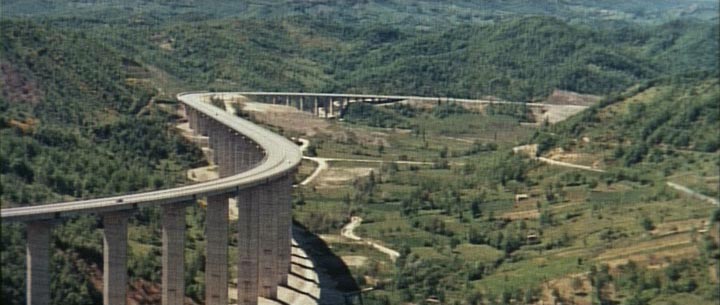
It is a long concrete snake which crawls through a green southern Italian valley, rising above with majesty. A gigantic highway bridge which fluidly carries cars coming from and going to places we will never know of. It is modernity in motion, arrogantly cutting through the past, ignoring those who can't follow its pace.
Down in its shadow, at the foot of the piles, lies a village, stuck in a timewarp. Remote from the movement above.

Two different worlds, living next to each other but completely separated. Yet interactions do occur, and this is the idea Non si sevizia un Paperino (Don't torture a Duckling - Lucio Fulci, 1972) is built on: describing and analysing the violent effects of the intrusion of urbanisation and modernisation in a conservative community.
This is why, contrary to what's being often said, this film is not a rural giallo. Giallo is a quintessentially contemporary and urban genre, and this one is no exception.

In fact, "Non sevizia..." can be considered a detailed report of the reactions of a body rejecting a transplant.

An emblematic symptom of the rejection: Patrizia (Barbara Bouchet). She is the girl who came from the city through the highway, driving a powerful Iso Lele. She lives in a house at the entrance of the village. Her home remains outside of the community though, both geographically and architecturally (a futuristic building in complete contrast with the traditional little white houses). To escape from the suffocating atmosphere of the village which ostracises her, she sometimes goes back to her natural element, the highway, and drives for hours for the sake of driving. Movement against immobility.
She also actively tries to convert the most permeable elements of the community to her libertarian lifestyle, by sexually teasing the young boys of the village.

Temptation is coming from outside. The same teenage boys can't help being intrigued by the regular visit of other outsiders : prostitutes coming from the city to give some nice time to a few workmen.
Temptation is a threat to the community; it jeopardises its future by corrupting youth and detracting them from traditions. It detracts them from the most important: religion.
Temptation implies change, when the main aspiration of this traditional land is to maintain a status quo.

So when the young boys start being murdered one after the other, the whole community stands as one, pointing at those who are considered outsiders: the village idiot, the sleazy city girl Patrizia and a poor mad woman considered a witch, Martiara (Florinda Bolkan).

But the death of the young boys is the brutal and obvious symptom of the village's rejection of the modern world: it's in fact from the deep heart of the community that the sacrifice of "corrupt sprouts" was perpetrated.


Don't Torture a Duckling is probably one of the best gialli ever made, and certainly a demonstration of Lucio Fulci's underestimated talent. It also ties back to the director's obsessions about the body, which he explored in most of his films. More on this theme from this blog here.

Sunday, November 06, 2005

Time-travelling on a jet


Part of the charm of Giallo is that it is dated. Clearly attached to a specific time: the 1970s.

Even though its themes are quintessentially Italian (references to religion, family, the place of women...), Giallo's imagery highly draws on the 1970s' international style: fashion, design, music, everything is an almost perfect encapsulation of this period, which could explain its worldwide appeal and why it's so easy to relate to it more than 30 years down the line.

This is to me the "materialistic" dimension of Giallo: it puts at the forefront of its cinematography all the concrete signs of international modern living of the times.
This typical 1970s contemporaneity is best illustrated by the recurring presence of international travels in the scenarios, through an a posteriori naive fascination for planes and airports. For an obvious reason: international travelling was becoming more accessible and one of the most high-profile symbols of the modern western society: just remember the Boeing 747 mythology.

Countless gialli start or end or are structured by travels on glamorous planes, giving birth to a new figure: the stranger caught abroad in a twisted plot, allowing for multiple points of view on cultural interactions. This is best shown in films like "The girl who knew too much", "The bird with the crystal plumage", "The case of the scorpion tale" or "Short night of the glass dolls", just to name a few.

Perfectly embracing the 1970s' modernity and spreading violence into it like a virus, no surprise Giallo could only then disappear with this decade.

Read Gary Needham's interesting article about the figure of the stranger & post-colonialism here.

Tuesday, July 26, 2005

The end of la dolce vita


In 1962, a Dino Risi film was released which is in my eyes an allegory on how Italy's golden years would end: tragically.
This film is Il Sorpasso, with Vittorio Gassman, Jean-Louis Trintignant and Catherine Spaak.

It can be considered as the first road-movie. Hopper himself admitted he got the inspiration for 1969's Easy Rider from Il Sorpasso.
Bruno (Gassman), an outspoken and lively dillettante, meets Roberto (Trintignant), a shy student, and they start a trip through Italy in a Lancia Aurelia B24 Spider.
The film is a point of view on the contradictions of post-war Italy. A fast and happy Italy: flashy sports cars overtaking antique bicycles on brand new roads, young people living a frenetic life on an upbeat jazz score (by Riz Ortolani), leaving the elder and their traditions behind.

Nothing seems to be able to calm this energy down.
Half way through the film though, our two travellers stop to look at a crash that has just happened between a car and a truck carrying fridges. At first it looks funny, with all the mess caused by the fridges which have fallen all over the road. But having a look around, they see a corpse on the macadam. The fun is over for an instant.
And then they take off again.
But at this moment we know the end will not be a happy one.

Il Sorpasso is an early glimpse at the end of "la dolce vita", on the ruins of which I believe the Giallo was born.

Il Sorpasso (AKA The easy life) is a great film you should not miss. It's difficult to find it but you can get it here (only available in France, unfortunately), and read French writer Marc-Edouard Nabe's article on Dino Risi there (in French).