Showing posts with label Poliziesco. Show all posts

Friday, December 15, 2006

The Milian Show


In the second half of the 1970s, Poliziesco had taken over Giallo in Italian popular cinema. Amongst the abundant production, two films are worth noticing as a somewhat unsuccessful attempt to mix the poliziesco filone with 'la comedia all'italiana'.

Definitely off-track, Il Trucido e lo Sbirro (aka Tough cops, Umberto Lenzi - 1976) and La banda del Trucido (aka Destruction force, Stelvio Massi - 1977) are in fact more innovative than one could think in the first place: whereas, in Italian genre cinema, characters are most of the time secondary to the intrigue or the set-up, scenarist Dardano Sacchetti tried in these movies to give depth and personality to a central character, shaped up by the writer's knowledge of Rome's working class culture: Monnezza - litterally "garbage" in Roman slang -, a bigger than life thug from Rome, played by the incredible Tomas Milian.

Wouldn't it be for Milian's pretty hilarious and spectacular incarnation of Monnezza, it has to be said that these two films are far from being unforgettable. Yet this misunderstood attempt at hijacking poliziesco to turn it into some sort of violent comedy stuffed with Roman popular humour remains noticeable: in La banda del Trucido for example, Monnezza owns a trattoria called "Alla Pernacchia" (try this on google to understand what it means) and welcomes his clients by insulting them and cracking jokes of utter vulgarity.

Cynicism and bad taste here are sometimes reminiscent of the Italian tragicomedies à la Scola (Brutti, Sporchi e Cattivi, aka Ugly, Dirty and Bad), even if it never reaches the same level because of inconsistencies in the structure of the films, which never really manage to succeed in merging two genres. As a result, the overall impression is that you watch rather mediocre polizieschi interrupted with regular bursts of outrageous comedy, overacted by a decidedly weird Tomas Milian.

This could have been really great, but as Dardano Sacchetti explains in an interview, it seems nobody shared the same vision of the films when they were produced.


The French production company Neo Publishing recently released the rare Il Trucido and its sequel in DVD, in their "Italia a mano armata" collection. Sadly, no English subtitles.
More on filone from this blog here.

Wednesday, September 06, 2006

Any resemblance to persons living or dead is purely coincidental


Does the name Susy Lion ring a bell? Probably not.
In 1973, Susy was part of an obscure band called "Susi and Guy", picked up by Guido & Maurizio de Angelis for a couple of songs included in their soundtrack for Milano Trema: la polizia vuole giustizia (Violent Professionals - Sergio Martino).
On the B-side of their 45 rpm, Susy sings in Italian a nice, lighthearted yet melancholic song called "And life goes on".

A memorable scene from the film opens on a lovely sunny morning, with Susy singing about her lover who has gone. The camera embraces a vast place in the center of Milan. Traffic is fluid and nice colourful cars zoom through the frame.
A taxi stops. An elegant middle-aged man gets off.
A few yards away, a woman walks up the stairs out of the tube station. She's carrying a shopping bag with fruits and vegetables. Before crossing the street, she puts her hair back in place.
Opposite the street, another woman is looking at a bakery's window while eating an ice cream.
Further down the street, a guy is sitting on a bench, reading the newspaper.

The guy who had got off the taxi now crosses the street. He knows where he's going. He is il comissario Del Buono. We know this from a previous scene in the film. And this police inspector is on a serious case, close to solve a big investigation.

As the love song goes on, we see a few kids cycling amongst the shadows of a building's pillars, in the background.
The man with the newspaper has left the bench. We follow him walking swiftly through the street.
Cut to inspector Del Buono, walking in the opposite direction. They're going to cross each other.
Kids in the background, woman with her shopping bag, the inspector's face, close up on the guy with the newspaper, close up on the newspaper hiding a gun, Del Buono's face, the guy with the paper shoots the gun as Del Buono walks to him, bang bang, woman screams and drops her shopping bag, Del Buono falls down on the pavement, a guy is running to help him, the newspaper man jumps into a car and in a second, he's gone.
Woman screaming. Guy bending over the body of inspector Del Buono. A few fruits roll out of the shopping bag before slowly coming to a stop.
Del Buono is lying on the ground. Dead.

Susy goes on singing about her lover who has gone.


This was Sergio Martino's personal take on the real murder of Inspector Luigi Calabresi in 1972, in the aftermath of the 1969 Piazza Fontana bombing in Milan.
Of course it's not meant to be historically exact, but it is an obvious example of the fact that "Violent Professionals", like most polizieschi, was built on the particular context of the Italian "anni di piombo" ("years of lead"). Another example is the key role of a publisher (played by Richard Conte) in subversive activities in the film: a striking connection with the real publisher Giangiacomo Feltrinelli who participated in radical left-wing activism in those days.
Although often simplistic, Poliziesco was definitely a political cinema genre.

Friday, July 14, 2006

Dance


If Giallo is an allegoric illustration of Italy's dark years, then Poliziesco, this other typical 1970s Italian genre cinema, is their very realistic, day-to-day report.

In Giallo, violence has no face as it can take anybody's identity.
In Poliziesco, criminals are all clearly identified: street punks, small-time thieves, dangerous gangsters, corrupted policemen or cynical politicians, all of them drawing the scary portrait of a seriously ill Italian society. Sometimes a simplistic portrait, yet sketched up in an ever efficient and graphic manner.

Like in "Il Cittadino si Rebella" (Street Law - Enzo G. Castellari, 1974), one of the highlights of the genre. From the first to the last second, this movie, based on the revenge of a banal citizen against the gangsters who brutally kidnapped him during a bank hold-up, is a breathless sequence of action scenes which have clearly been used as Tarantino or John Woo's back catalogue for their own films.

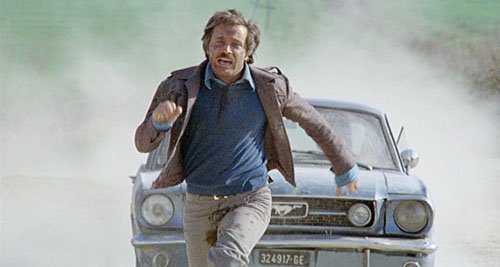
One amazing scene. Carlo Antonelli (Franco Nero) is running for his life, chased by a gangster's Ford Mustang. This scene is under influence: it's a western scene, with the Mustang moving like an infuriated horse. It's also a tribute to Hitchcock's "North by Northwest", with its strange similarity between Franco Nero and Cary Grant's run to escape a machine.

Above all, this scene is a ballet, a deadly choregraphy between a man and a machine, shot like contemporary dance, from sophisticated angles, with the camera accompanying the agressive and desperate movements of the car and its prey, in slow motion to stress their beauty, in close-ups to enhance the brutal feeling of fear.

The uglier the reality, the more beautiful its representation.


"Il Cittadino si Rebella" is a very good introduction to Poliziesco. Its score, by Guido & Maurizio de Angelis, is inspired by early 70s American cop movies and has some definitive Blaxploitation influences.
More about this cinema genre on this great site: Pollanet Squad (in Italian).

Thursday, November 17, 2005

Milano's ambiguity


I was in Milan this week.
Walking through the city's streets, around la piazza del Duomo, taking the so vintage underground... Because of all these 1970s Italian movies I'm watching, I guess my eyes are probably seeing a distorded reality and I was feeling like taking a walk through a movie set, more than visiting a 2005 city.

Milan lends itself to this cinematographic impression: the spectacular vertical and greyish architecture, the vast places, the yellow tram and its suspended wires above long and straight avenues, and also the little dark streets, the vintage pavement, the small shops still decorated with wooden walls and their crude neon lights. It all looks like time is only slowly making its way in, even though the city is agitated by its people's liveliness, this Italian talking which is like a song to foreign ears. There is an odd modernity to this atypical Italian city.

Indeed, in terms of urbanism and architecture, it feels more north-eastern european than anything else: dark and austere, yet very charming.
There's a peculiar vibe here, and I haven't decided yet whether it's a threatening or exciting one. Probably both. I love Milano's ambiguity.

Milan was extensively used in the "Poliziesco", this other genre which started just after Giallo. Less imaginative but even more strongly linked to the political and social context of the Italian 1970s.
A great site to learn more: Pollanet Squad.