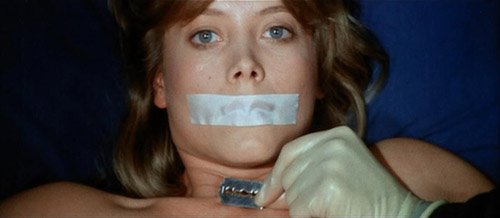
1982. New York has one of the highest criminality rates of the cities of the world. It epitomises more than any other place the modern Babylon.
1982. Giallo's golden years are far behind. In fact the genre has slowly died in the second half of the 70's, clearing the ground for new 'filones' going even further in the visual representation of violence: the most well-known being the zombies and cannibal genres.
The 'after-giallo' Italian cinema is somewhat a desperate and vain race to reach new heights in shocking audiences, against the ineluctable rise of television.
1982. Lucio Fulci's "New York Ripper" is released and soon becomes famous because of the multiple problems the film encounters with censorship boards in most countries.
Nearly 25 years after, this infamous shocker is still widely debated: a masterpiece or a rip-off? a giallo or a slasher? Should the killer have a Donald Duck voice or shouldn't he?
The anti-aesthetical core principle of "The New York Ripper" - the raw photography, the run-down locations, the miserable characters... - makes this film philosophically incompatible with Giallo.
At the same time, the complete absence of any puritanistic or moral subtext which is slasher's trademark doesn't allow to affiliate the film to this typically American genre.
It's hard to classify "the Ripper". It is so cynical and nihilistic it is almost an experimental object.
In fact, it could be compared with porn as it uses a similar parasitic approach: diverting a rather classic and well-coded cinema style to use it to its own advantage. When porn leverages any stereotypical scenaristic frame as a pretext to fit in as many porn scenes as possible, Fulci hijacks the early 80s American cop film codes and structure to stuff it with ultra-violent (and sometimes almost pornographic) sequences.
This method makes the film both very flat and very paroxystic at the same time. Flat because the scenario is incredibly predictable, linear and, at the end of the day, banal as it is a stereotypical American cop movie, of which Fulci has respected all the codes, including the cheesy score. Paroxystic because this banality is meticulously dynamited from the inside by the regular occurence of voyeuristic and disturbing peaks of violence. Hence an overall feeling of heterogeneity.
In its Italian DVD edition, "The Ripper's" bonuses consist in all the murder scenes in their uncut versions. After watching everything, you get this odd feeling that these bonuses, the murder scenes seen in isolation, embody in fact the purest version of the film. They don't need any scenaristic frame around them to work efficiently. They are its 'raison d'être'. As if Fulci, in an afterthought, had been forced to find a scenario to wrap these scenes in order to be able to produce the movie.
Again, just like porn.
That does not solve the question of the killer talking with a Donald Duck voice, a detail considered original by some, grotesque by others. What's for sure is that it is on behalf of Fulci an intentional disrespect for the rules of the American cop movie: killers don't have a ridiculous voice like Donald Duck's. But what if it was an ironic statement on US subculture?
Yes the world can also be terrorised by Disney's creatures.
"Lo squartatore di New York" is widely available in dvd (US/IT/FR) and its 80s funk influenced score can be found here.