Showing posts with label Gianni Ferrio. Show all posts

Tuesday, March 13, 2007

Bringing something subtle to the table


How can you get away with using a chainsaw in a Giallo so it does not feel gross?
First, if you are Duccio Tessari, who knows how to make beautiful images, it helps. Then, you can set your film in Portofino, a rather eye-pleasing scenery.
This is the case for "L'uomo senza memoria" (Puzzle, 1974), which I previously talked about.

But the secret weapon is having your score composed by Gianni Ferrio, one of the most elegant film music composers of the golden years of Italian genre cinema.

From the very first seconds of the film, you cannot help being transported by the opening piece, "Labyrinthus", sung by Rosella. Ferrio's trademark, exquisite and crafted melodies, is once again performing magic to get you in the movie as we see shots of London streets, where the story starts.

Let me insist on this: in this film, it is the music which leads the film and sets the theme and the mood. "Labyrinthus" could have been the movie title, as it perfectly encapsulates what this giallo is about. The intricacies of memory and how a man struck with amnesia is faced with snapshots of his dark past life.
How this past is actually reconstructed step by step through both the reactions of people around him and the images and feelings these reactions trigger in his failing memory.

A man lost in the labyrinth of his mind, hesitating, in doubt, anxious, and one guide only throughout the film: the music, which literally works as the backbone of the story and holds the pieces of the puzzle together.

Until the end where, all of a sudden, we are ourselves in doubt: is that man without a memory a victim, or could he be a great manipulator?
Just the shadow of a doubt.


Not only is "L'uomo senza memoria" a very good giallo, but its score by Gianni Ferrio is one of the best in class and Digitmovies have just released it. Listen to it and buy it here.
More on the film from this blog there.

Tuesday, September 26, 2006

The odd detail


Not that far from the urban landscapes of Northern Italy, lies a lovely city by the seaside.
Portofino. Its harbour, its small colourful houses, its relaxed atmosphere. Strange place for a giallo.

Is L'uomo senza memoria (Man without a memory aka Puzzle, Duccio Tessari - 1974) really a giallo? Not sure, but it's probably Tessari's trademark: his other contribution to the genre, Una farfalla con le ali insanguinate (The bloodstained butterfly, 1971) wasn't exactly a typical giallo either. There is something that cannot be denied: both films have their own particular style, and a remarkable elegance - something "precious" which makes them stand out of the crowd.

So, here we are in London with the story of a man who has lost his memory, and is attracted to Portofino by a letter supposedly written by his wife, whom he doesn't remember.
And the location is so beautiful, with the boats and the twisted paved streets,
and the characters all dress up in fashionable clothes, and there are nice cars too,
there's a witty kid, who helps solving the mystery,
there is also Anita Strindberg, and a bad guy who blows his nose all the time,
there's even a subtle tribute to Mario Bava's "La ragazza che sapeva troppo" when Sara (Senta Berger) is alone in the shadows of her house at night, as she's heard a strange noise...
Not to forget the soundtrack which is so classy, as ever with the great Gianni Ferrio.

All these elements contribute to make this film a definitely pleasant experience, something classy not quite fitting in the giallo frame, still very close to it.
Like an elegant painting made of a number of carefully selected details perfectly matching together, except for one. One detail which presence in the painting would seem very odd. Not something big, but sufficiently disturbing to make you rethink of the whole picture with a different look.
In L'uomo senza memoria, this odd detail appears shortly at the very beginning of the film only to find its utility at the very end of it: it is a chainsaw. Yes, a chainsaw which turns the final scene into a bloodbath, after 90 almost violence-free minutes.

Such an odd detail, which is typically constitutive of Puzzle's strange charm.


The film was recently released by two production companies: the French Neo Publishing and the Danish Another World Entertainment. The soundtrack, unfortunately, seems nowhere to be found, which is a shame considering Gianni Ferrio's consistently excellent scores.
More from this blog on Duccio Tessari's other giallo here and there.

Tuesday, March 21, 2006

Take a walk with Gianni


Take a walk with Gianni Ferrio.
Or rather, let him take you for a walk throughout the refined paths of his elegant melodies.

Gianni Ferrio is a much less well-known composer than Morricone, especially in Giallo. Yet his music stands for me as the most delightful surprise of the genre's soundtracks.

It's particularly interesting noticing the differences between both musicians in the composition structure.
Morricone builds his scores on a simple and recurring theme, which somehow works like stones thrown on the water's surface: bouncing and developing circles in waves which grow and vanish, always moving back and forth. An almost fractal musical structure, both very tight and loose at the same time, which made his signature and probably produced the most beautiful themes ever written for films.

If Gianni Ferrio does not have this incredible consistency and strength within his own themes, he is definitely immensely talented for something different, very much ahead of its time: coming up with deliciously crafted pop melodies encapsulated in a mix of jazz and classical structure. This cross-over of musical genres is so natural in his compositions that it comes across effortlessly.

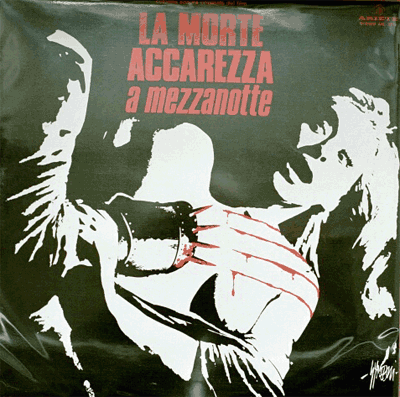
La Morte Accarezza a Mezzanotte is a great example: its theme was built on the main character, Valentina, like a pop-sounding starting point of both the film and the score, which later takes us through more jazzy sounds, nice acid jazz party snapshots and eventually easy listening flavours. It really feels like visiting a house: the general atmosphere remains consistent but depending on the moment and the room you're in, the atmosphere changes and you experience a variety of tunes few composers can compete with.

Another fantastic score is Una Farfalla con le Ali Insanguinate, which manages to mix Tchaikovsky's Concerto no.1 with a jazz tune and makes it sound perfectly elegant and balanced. Again this soundtrack feels like taking a nice walk through the park of an old house which classy owners all have something to hide. Not to forget this very melancholic core theme, reflecting the bitter reality behind a glossy surface depicted by the film. One of these scores which is completely tailor-made for the film yet has a life of its own.

Thanks for the nice walks, dear Signore Ferrio.


Gianni Ferrio's giallo soundtracks and more are available at Movie Grooves.

Thursday, January 26, 2006

The first impression matters


On the music of Gianni Ferrio's extremely elegant soundtrack,
framed by the silhouette of a butterfly,
a blue Fiat 124 Spider zooms on a small Italian country road.
It's driven by a very stylish brunette who eventually stops the car in front of her house.

Then the camera smoothly pans to introduce the other characters of the drama, caught in various places at the same moment. They are identified by carefully designed supers indicating their names and their respective links - exactly like a filmed version of a character list in a play.

This is the very sophisticated opening sequence of Una farfalla con le ali insanguinate (The bloodstained butterfly - Duccio Tessari, 1971), a giallo which could well be of a different flavour.


More about this film soon. In the meantime, find the movie here and do not miss Ferrio's great blend of classic and jazz melodies there.

Thursday, December 15, 2005

Edwige's rival


Milan, 1973. To the melody of a sophisticated easy-listening tune, a beautiful young woman decidedly walks into the hall of a modern building and starts joking with the portier.
From the first second, we know that she will not be the usual Giallo heroine - fragile, scared and vulnerable.

As Gianni Ferrio's beautiful music theme goes on, a choir of singers reveals her name: Valentina.
Valentina is Susan Scott, aka Nieves Navarro. In "Death walks at midnight" (Luciano Ercoli, 1973), she introduces a new feminine figure in the genre: empowered, hot tempered and all but shy; she's the screaming queen with an attitude.
A very interesting feminist take on the Giallo heroine, perfectly symmetric to the usual Edwige Fenech part.

Valentina/Susan Scott is very much at the core of the film and definitely drives it from the start.
Not fully though: the first sequence shows her, a fashion model, being set up by her boyfriend in an experimental photoshoot on drugs - where she becomes the witness of a murder. While she thought the experiment would remain anonymous, the next day she finds herself on the cover of a tabloïd which headline reads: "Valentina under the effect of HDS".

Then she starts being very angry.


If "La Morte accarezza a Mezzanotte" is not a great giallo, it is certainly very sophisticated from a cinematographic point of view, and its score is one of the most interesting I've come accross, clearly contributing to the great aesthetics of the film.