Showing posts with label Duckling. Show all posts

Thursday, March 01, 2007

Into Fulci


"[Fulci] uses the position of the camera to define the moral and emotional weight of his scenes; each shot is a judgement, an act of involvement. [...] Fulci either keeps his distance, shooting from a height, or zooms in as if to point his finger".

I recently came across three articles about Lucio Fulci on the Bad Zero blog, which lay out some highly insightful thoughts on the director's unique style and approach to filming.

Check these two general articles here and here (the latter notably covers "A lizard in a woman's skin") and another one there, which gives an excellent point of view on "Don't torture a duckling" while drawing an interesting comparison with Almodovar's cinema.

Friday, June 23, 2006

Witch hunt


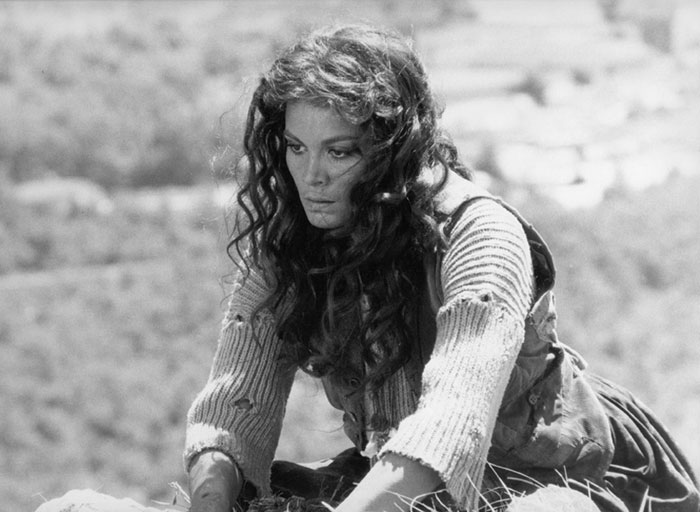
Marciara (Florinda Bolkan) leaves the village's police station in the early morning. She walks through the empty square, amongst the little white houses. She's free.
She had been arrested the day before, suspected of being the killer of three young boys. In fact she did not deny. She told the police she was guilty. She hysterically explained why she wanted to punish them and proudly described how she did black magic to do make the young boys die.
Yes she's the killer, and she's a witch!

Only trouble is the boys were strangled, a more down-to-earth way to die. Therefore Marciara the Witch can only be innocent. The rational thinking of the police sets her free, but also leaves her completely empty: if she has no magic power, then who is she but just a poor mad woman?

Now her mad eyes have turned to a sad and resignated expression, while she walks through the small streets of the village. She is harmless, she won't scare anybody anymore.
Yet the village inhabitants look at her suspiciously - after all, there's always been something wrong with that woman. She is the witch, so it's likely she killed their children.
They look at her as she walks past them. A look that sentences her to death.

On the way to her hideaway in the mountains, out of the village, she suddenly hears a noise. She knows exactly what is happening, and tries to run to hide in the graveyard nearby.
Too late. The villagers immediately catch her. Three of them, armed with wooden sticks and iron chains. They've turned on their car stereo loud, so nobody can hear the witch screaming.

The radio plays "
Quei Giorni Insieme a Te", by Ornella Vanoni, a beautiful song which becomes the soundtrack of her agony.

Bleeding and almost unconscious, she crawls in the dust to reach for the highway, where happy families pass by in their cars, not even seeing her.
There, a few meters from the asphalt, Marciara will die.
The modern world is oblivious to the death of a poor mad woman.


This extremely violent beating scene from Lucio Fulci's "Don't torture a duckling" is one of this masterpiece's highlights, thanks to Florinda Bolkan's stunning talent and Riz Ortoloni's evocative music which both give this moment an incredibly powerful emotional dimension. Get the score here and read more about this film here and there.

Tuesday, June 13, 2006

Kids


Gialli often reflect a point of view on Italy's moral and political crisis of the 70s (Short night of the glass dolls, The bloodstained butterfly...). But it was nearly always made through a very sophisticated vision of the world, the aesthetical treatment moving away from an objective depiction of reality. Giallo is an allegoric cinema genre.

Except for Lucio Fulci's Don't torture a duckling, which could be considered a giallo born out of Neo-Realism.

Beyond the plot, this film has a documentary feel, turning the viewer into a witness of the accelerated modernisation of Italy in the 60s & 70s, depicting the country's evolution through the very ones remaining untouched by change: poor and rural people.
A testimony on a schizophrenic country, stretched out between the extremes of tradition and modernity.
Neo-realist films were clearly about this particular topic after the desolation of WWII: witnesses of the Italian reconstruction, often symbolised by kids (Vittorio de Sica's "Bicycle Thief", Roberto Rossellini's "Open City", amongst many others).

Kids.
In Fulci's film, they clearly embody the link between the old and new Italy.
They are the perpetuation of traditions, under the strict rules of Religion that will ensure this little village living at the foot of a brand new highway will remain untouched.
Yet the kids are irremediably attracted by the promises of the modern world coming from the highway. They are the living connection with this new world, letting temptations and alien cultures in. So much so that they end up becoming a threat to the village community, bringing change and disorder.
In a terrifying reflex of self-preservation, the community chooses to cut this dangerous link out to maintain its integrity.

The community chooses to kill the kids. It's the end of hope.
We are, indeed, in a giallo.


More on Neo-Realism here. And on "Don't Torture a Duckling" from this blog there.

Thursday, June 01, 2006

The transplant


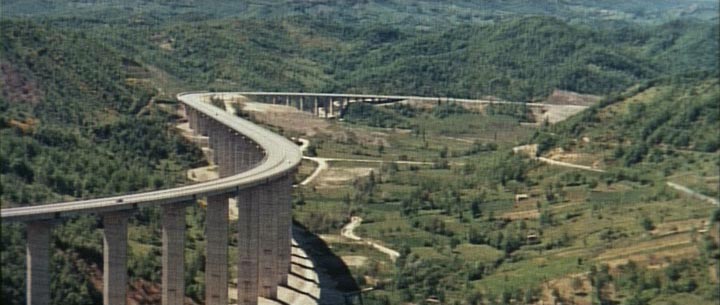
It is a long concrete snake which crawls through a green southern Italian valley, rising above with majesty. A gigantic highway bridge which fluidly carries cars coming from and going to places we will never know of. It is modernity in motion, arrogantly cutting through the past, ignoring those who can't follow its pace.
Down in its shadow, at the foot of the piles, lies a village, stuck in a timewarp. Remote from the movement above.

Two different worlds, living next to each other but completely separated. Yet interactions do occur, and this is the idea Non si sevizia un Paperino (Don't torture a Duckling - Lucio Fulci, 1972) is built on: describing and analysing the violent effects of the intrusion of urbanisation and modernisation in a conservative community.
This is why, contrary to what's being often said, this film is not a rural giallo. Giallo is a quintessentially contemporary and urban genre, and this one is no exception.

In fact, "Non sevizia..." can be considered a detailed report of the reactions of a body rejecting a transplant.

An emblematic symptom of the rejection: Patrizia (Barbara Bouchet). She is the girl who came from the city through the highway, driving a powerful Iso Lele. She lives in a house at the entrance of the village. Her home remains outside of the community though, both geographically and architecturally (a futuristic building in complete contrast with the traditional little white houses). To escape from the suffocating atmosphere of the village which ostracises her, she sometimes goes back to her natural element, the highway, and drives for hours for the sake of driving. Movement against immobility.
She also actively tries to convert the most permeable elements of the community to her libertarian lifestyle, by sexually teasing the young boys of the village.

Temptation is coming from outside. The same teenage boys can't help being intrigued by the regular visit of other outsiders : prostitutes coming from the city to give some nice time to a few workmen.
Temptation is a threat to the community; it jeopardises its future by corrupting youth and detracting them from traditions. It detracts them from the most important: religion.
Temptation implies change, when the main aspiration of this traditional land is to maintain a status quo.

So when the young boys start being murdered one after the other, the whole community stands as one, pointing at those who are considered outsiders: the village idiot, the sleazy city girl Patrizia and a poor mad woman considered a witch, Martiara (Florinda Bolkan).

But the death of the young boys is the brutal and obvious symptom of the village's rejection of the modern world: it's in fact from the deep heart of the community that the sacrifice of "corrupt sprouts" was perpetrated.


Don't Torture a Duckling is probably one of the best gialli ever made, and certainly a demonstration of Lucio Fulci's underestimated talent. It also ties back to the director's obsessions about the body, which he explored in most of his films. More on this theme from this blog here.

Tuesday, July 19, 2005

Titles 2 (The bestiary)

Italian giallo titles really sound nice to my ears:
L’uccello dalle piume di cristallo
, Una lucertola con la pelle di Donna, Il gatto a nove code, Non si sevizia un paperino, Quattro mosche di velluto grigio, Il gatto dagli occhi di giada, La coda dello Scorpione, Sette scialli di seta gialla.

(The bird with the crystal plumage, A lizard in a woman’s skin, The cat o’nine tails, Don’t torture a duckling, Four flies on grey velvet, The Cat with the Jade Eyes, The case of the scorpion tail, Crimes of the black cat).

Cats, birds, scorpions, lizards, ducks, flies...

In the Middle-Age in Europe, the fear of the Devil being able to sneak into people's bodies led to the idea of the "beast within".

Being possessed, people would lose their judgement and spirituality and would act like animals - led by hunger, envy and rage.
Hence the Devil was often represented as an animal (cat, snake, goat...) or as a hybrid of human and animal.

This shades a new light on the highly symbolic and recurrent presence of animals within the vocabulary of giallo titles, which is a bestiary in itself.

Two interesting books study the relationship between the Devil and animals: "Une histoire du diable", by R. Muchembled (in French) and "The beast within: Animals in the Middle Ages", by J.E. Salisbury.
Read also a previous post about giallo titles.