Thursday, October 12, 2006

Early Marketing Trick


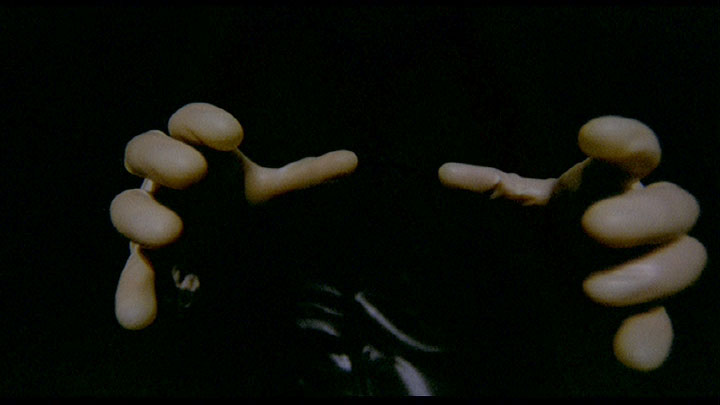
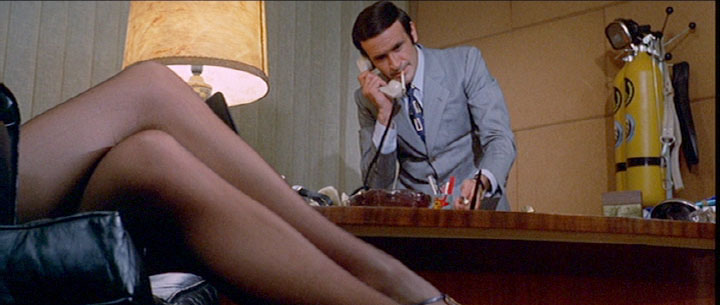
When they have a serious explanation, Edwige Fenech & George Hilton pour themselves a glass of it.
Susan Scott enjoys it with a cigarette, in her cosy boudoir.
From time to time, Luc Merenda gets some.
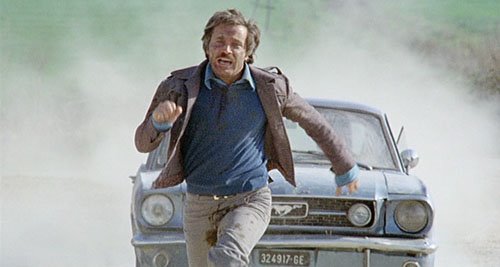
Franco Nero likes it so much he drinks it while driving.
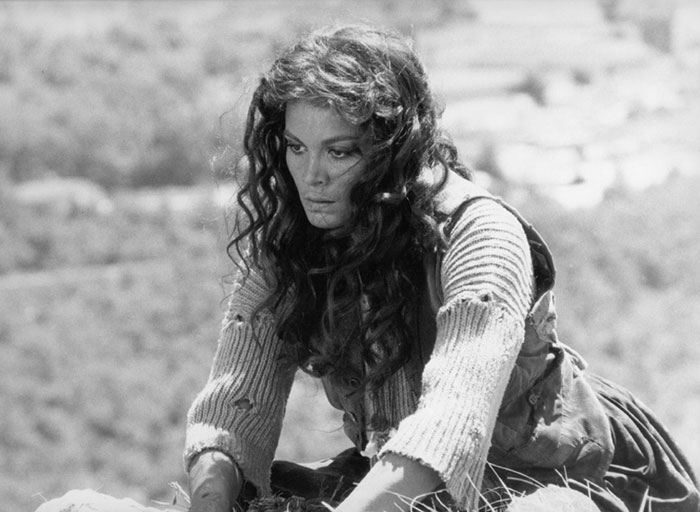
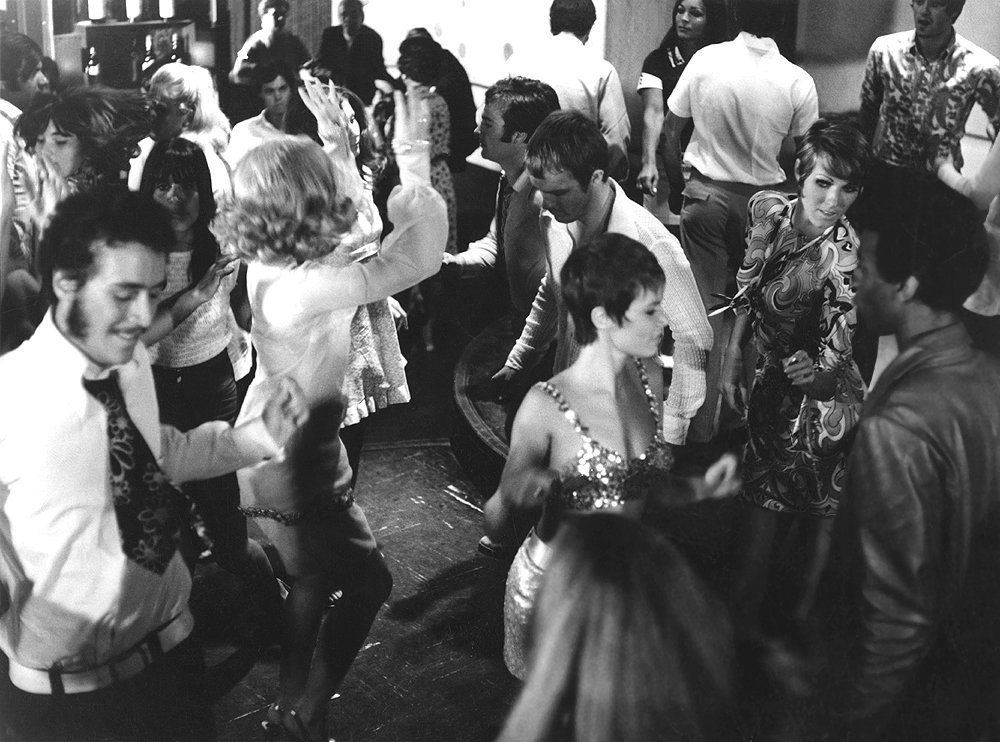
Anita Strindberg indulges on it with Florinda Bolkan, during a wild party.
Not to mention Jean Sorel, who was spotted with a bottle in his flat.

Yes, J&B is the official Giallo drink.
Which shows that product placement in movies is not a recent idea.

J&B's Italian marketing director was certainly a man of taste, yet image cannot change reality: even with the glamour of Italian genre cinema, it remains a terrible whisky.

Saturday, September 30, 2006

Films I talked about in June, July, August & September


L'uomo senza memoria (Man without a memory AKA Puzzle) - Duccio Tessari - 1974

Milano trema: la polizia vuole giustizia (Violent Professionals) - Sergio Martino - 1973

Romanzo Criminale - Michele Placido - 2006

Il Caimano - Nanni Moretti - 2006

Arrivederci mi amore, ciao - Michele Soavi - 2006

Il cittadino si rebella (Street Law) - Enzo G. Castellari - 1974

Non si sevizia un Paperino (Don't torture a Duckling) - Lucio Fulci - 1972 - 1 /2 / 3


Specific topics
The films of Luciano Ercoli
Great soundtrack places on the web


See also the films I previously talked about.

Tuesday, September 26, 2006

The odd detail


Not that far from the urban landscapes of Northern Italy, lies a lovely city by the seaside.
Portofino. Its harbour, its small colourful houses, its relaxed atmosphere. Strange place for a giallo.

Is L'uomo senza memoria (Man without a memory aka Puzzle, Duccio Tessari - 1974) really a giallo? Not sure, but it's probably Tessari's trademark: his other contribution to the genre, Una farfalla con le ali insanguinate (The bloodstained butterfly, 1971) wasn't exactly a typical giallo either. There is something that cannot be denied: both films have their own particular style, and a remarkable elegance - something "precious" which makes them stand out of the crowd.

So, here we are in London with the story of a man who has lost his memory, and is attracted to Portofino by a letter supposedly written by his wife, whom he doesn't remember.
And the location is so beautiful, with the boats and the twisted paved streets,
and the characters all dress up in fashionable clothes, and there are nice cars too,
there's a witty kid, who helps solving the mystery,
there is also Anita Strindberg, and a bad guy who blows his nose all the time,
there's even a subtle tribute to Mario Bava's "La ragazza che sapeva troppo" when Sara (Senta Berger) is alone in the shadows of her house at night, as she's heard a strange noise...
Not to forget the soundtrack which is so classy, as ever with the great Gianni Ferrio.

All these elements contribute to make this film a definitely pleasant experience, something classy not quite fitting in the giallo frame, still very close to it.
Like an elegant painting made of a number of carefully selected details perfectly matching together, except for one. One detail which presence in the painting would seem very odd. Not something big, but sufficiently disturbing to make you rethink of the whole picture with a different look.
In L'uomo senza memoria, this odd detail appears shortly at the very beginning of the film only to find its utility at the very end of it: it is a chainsaw. Yes, a chainsaw which turns the final scene into a bloodbath, after 90 almost violence-free minutes.

Such an odd detail, which is typically constitutive of Puzzle's strange charm.


The film was recently released by two production companies: the French Neo Publishing and the Danish Another World Entertainment. The soundtrack, unfortunately, seems nowhere to be found, which is a shame considering Gianni Ferrio's consistently excellent scores.
More from this blog on Duccio Tessari's other giallo here and there.

Wednesday, September 06, 2006

Any resemblance to persons living or dead is purely coincidental


Does the name Susy Lion ring a bell? Probably not.
In 1973, Susy was part of an obscure band called "Susi and Guy", picked up by Guido & Maurizio de Angelis for a couple of songs included in their soundtrack for Milano Trema: la polizia vuole giustizia (Violent Professionals - Sergio Martino).
On the B-side of their 45 rpm, Susy sings in Italian a nice, lighthearted yet melancholic song called "And life goes on".

A memorable scene from the film opens on a lovely sunny morning, with Susy singing about her lover who has gone. The camera embraces a vast place in the center of Milan. Traffic is fluid and nice colourful cars zoom through the frame.
A taxi stops. An elegant middle-aged man gets off.
A few yards away, a woman walks up the stairs out of the tube station. She's carrying a shopping bag with fruits and vegetables. Before crossing the street, she puts her hair back in place.
Opposite the street, another woman is looking at a bakery's window while eating an ice cream.
Further down the street, a guy is sitting on a bench, reading the newspaper.

The guy who had got off the taxi now crosses the street. He knows where he's going. He is il comissario Del Buono. We know this from a previous scene in the film. And this police inspector is on a serious case, close to solve a big investigation.

As the love song goes on, we see a few kids cycling amongst the shadows of a building's pillars, in the background.
The man with the newspaper has left the bench. We follow him walking swiftly through the street.
Cut to inspector Del Buono, walking in the opposite direction. They're going to cross each other.
Kids in the background, woman with her shopping bag, the inspector's face, close up on the guy with the newspaper, close up on the newspaper hiding a gun, Del Buono's face, the guy with the paper shoots the gun as Del Buono walks to him, bang bang, woman screams and drops her shopping bag, Del Buono falls down on the pavement, a guy is running to help him, the newspaper man jumps into a car and in a second, he's gone.
Woman screaming. Guy bending over the body of inspector Del Buono. A few fruits roll out of the shopping bag before slowly coming to a stop.
Del Buono is lying on the ground. Dead.

Susy goes on singing about her lover who has gone.


This was Sergio Martino's personal take on the real murder of Inspector Luigi Calabresi in 1972, in the aftermath of the 1969 Piazza Fontana bombing in Milan.
Of course it's not meant to be historically exact, but it is an obvious example of the fact that "Violent Professionals", like most polizieschi, was built on the particular context of the Italian "anni di piombo" ("years of lead"). Another example is the key role of a publisher (played by Richard Conte) in subversive activities in the film: a striking connection with the real publisher Giangiacomo Feltrinelli who participated in radical left-wing activism in those days.
Although often simplistic, Poliziesco was definitely a political cinema genre.

Thursday, August 24, 2006

Anni di piombo

"Romanzo Criminale" - 2005


"Le anni di piombo" ("the years of lead").
This decade during which, between december 12, 1969 and August the 2nd, 1980, Italy saw its foundations crumble under left and right-wing terrorism in what is referred to by historians as "a low intensity civil war".

Strange coincidence, 30 years after, three Italian films released this year are looking back at this troubled period of their country: Michele Placido's 'Romanzo Criminale' (based on judge Giancarlo de Cataldo's eponymous novel), Nanni Moretti's 'Il Caimano' and Michele Soavi's 'Arrivederci amore, ciao' - the latter being well know from giallo fans for his 'Dellamorte dellamore' (1994).

Romanzo Criminale
is probably the most spot on as it directly addresses the political events of the 1970s, building on the true story of a Rome gang which took advantage of the political mess to rise and conquer the city. Their path often crosses history, highlighting the ambiguous relationship between criminality, politics and terrorism during these years, until the Bologna railway station massacre in 1980.
Historically accurate, with a good cast and an efficient soundtrack, Romanzo Criminale is a must-see for anyone interested in understanding better what Italy was like in those days (not to mention the "poliziesco" style of the film).

As if it was a follow up to this first film, Arrivederci mi amore, ciao is the tale of a former political activist coming back to Italy nowadays, after years spent hiding in Latin America. Also adapted from a book by Massimo Carlotto, it depicts a pretty dark reality, showing how a man initially in search of starting a normal life is finally falling back into the dark side.

Finally, Il Caimano. Beyond the political statement about Berlusconi, this is a beautiful film about Italian genre cinema and its decline (when private TV rose in Italy, during the 80s).
It's also an emotional story of a family broken up by a divorce, as the main character, a has-been film director who used to be successful with B-movies during the 70s, progressively realises that his wife is walking away from him and his fantasies.
In order not to sink, he throws himself into a seemingly impossible project: making a movie denunciating the unclear origins of Berlusconi's overwhelming political and economical power. Somehow, an allegory about how cinema can still be a subversive power, and how genre cinema used to fulfill this role thirty years ago.

Overall, Moretti doesn't sign a movie directly about the anni di piombo, but certainly raises questions about the new powers which rose after the 70s and their consequences on the current Italian political structure - On a lighter note, but not to be missed, is the hilarious tribute to genre cinema in a memorable scene where an evil food critic is being murdered in a restaurant he had criticised.

Three films, three angles to reach a similar conclusion: not only have the mysteries of 1970s Italy not been completely elucidated, but they still have a strong influence on today's Italian society.


It seems that these films are not that easy to get to watch beyond Italy and France - apart from "Il Caimano", which was presented in Cannes this year. A shame as they're very insightful for anyone interested in the strong connections between Italian genre cinema and the history of the country in the 1970s.

Sunday, August 13, 2006

The connoisseur and his lady


In three years and three films, the Luciano Ercoli-Susan Scott duo left a touch of their own to Giallo, before disappearing with a large sum of money Ercoli had suddenly inherited from a relative.

Lots have been said about Ercoli/Scott's films bringing a feminist point of view to the genre, and there is no question about it: for the first time in this otherwise rather machist production, women were empowered and key to the plots (on this topic, read this interesting review of "Forbidden photos" and a previous article from this blog).

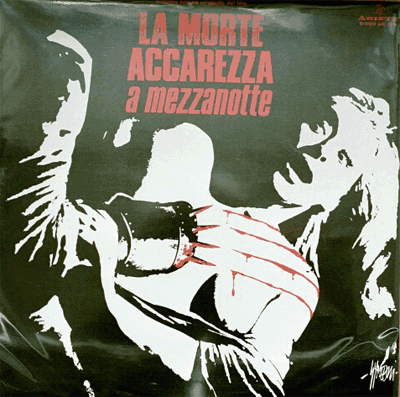
Despite this undeniable emphasis put on women, almost as a political statement, it is also interesting to see "Le foto proibite di una signora per bene" (1970), "La morte camina con i tacchi alti" (1971) and "La morte accarezza a mezzanotte" (1972) as visual testimonies of what state-of-the-art fashion and design meant in early 70s' Europe.
Building on glamourous lifestyles (Susan Scott is either a model or a dancer or even a lady with no other known activity than just taking pleasure out of life), these three movies are definitely landmarks of the genre: skirts, dresses, sunglasses, handbags, make-up and wigs - just remember Dagmar Lassander in "Photos..." - are displayed in an endless ballet, turning the movies into 90 minutes-catwalks in which the star of the show would be Susan Scott.

And indeed Susan Scott - aka Nieves Navarro - shines like a star in her boyfriend's movies. Everytime she's on screen she becomes the main focus and grabs attention like no other. So much so that when she disappears half-way through in "La morte camina con i tacchi alti", the film is somehow loosing its substance.
Evidence that in the end, all three movies would certainly not have been the same if Luciano Ercoli, decidedly a connoisseur, hadn't been in love with Susan Scott, decidedly a lady with an attitude.


"Le foto proibite di una signora per bene" (Forbidden photos of a lady above suspicion - 1970), "La morte camina con i tacchi alti" (Death walks on high heels - 1971) and "La morte accarezza a mezzanotte" (Death walks at midnight - 1972) are three highly enjoyable gialli, with an outstanding collection of soundtracks composed respectively by Morricone, Stelvio Cipriani and the great Gianni Ferrio. Don't miss them.

Friday, July 14, 2006

Dance


If Giallo is an allegoric illustration of Italy's dark years, then Poliziesco, this other typical 1970s Italian genre cinema, is their very realistic, day-to-day report.

In Giallo, violence has no face as it can take anybody's identity.
In Poliziesco, criminals are all clearly identified: street punks, small-time thieves, dangerous gangsters, corrupted policemen or cynical politicians, all of them drawing the scary portrait of a seriously ill Italian society. Sometimes a simplistic portrait, yet sketched up in an ever efficient and graphic manner.

Like in "Il Cittadino si Rebella" (Street Law - Enzo G. Castellari, 1974), one of the highlights of the genre. From the first to the last second, this movie, based on the revenge of a banal citizen against the gangsters who brutally kidnapped him during a bank hold-up, is a breathless sequence of action scenes which have clearly been used as Tarantino or John Woo's back catalogue for their own films.

One amazing scene. Carlo Antonelli (Franco Nero) is running for his life, chased by a gangster's Ford Mustang. This scene is under influence: it's a western scene, with the Mustang moving like an infuriated horse. It's also a tribute to Hitchcock's "North by Northwest", with its strange similarity between Franco Nero and Cary Grant's run to escape a machine.

Above all, this scene is a ballet, a deadly choregraphy between a man and a machine, shot like contemporary dance, from sophisticated angles, with the camera accompanying the agressive and desperate movements of the car and its prey, in slow motion to stress their beauty, in close-ups to enhance the brutal feeling of fear.

The uglier the reality, the more beautiful its representation.


"Il Cittadino si Rebella" is a very good introduction to Poliziesco. Its score, by Guido & Maurizio de Angelis, is inspired by early 70s American cop movies and has some definitive Blaxploitation influences.
More about this cinema genre on this great site: Pollanet Squad (in Italian).

Friday, June 23, 2006

Witch hunt


Marciara (Florinda Bolkan) leaves the village's police station in the early morning. She walks through the empty square, amongst the little white houses. She's free.
She had been arrested the day before, suspected of being the killer of three young boys. In fact she did not deny. She told the police she was guilty. She hysterically explained why she wanted to punish them and proudly described how she did black magic to do make the young boys die.
Yes she's the killer, and she's a witch!

Only trouble is the boys were strangled, a more down-to-earth way to die. Therefore Marciara the Witch can only be innocent. The rational thinking of the police sets her free, but also leaves her completely empty: if she has no magic power, then who is she but just a poor mad woman?

Now her mad eyes have turned to a sad and resignated expression, while she walks through the small streets of the village. She is harmless, she won't scare anybody anymore.
Yet the village inhabitants look at her suspiciously - after all, there's always been something wrong with that woman. She is the witch, so it's likely she killed their children.
They look at her as she walks past them. A look that sentences her to death.

On the way to her hideaway in the mountains, out of the village, she suddenly hears a noise. She knows exactly what is happening, and tries to run to hide in the graveyard nearby.
Too late. The villagers immediately catch her. Three of them, armed with wooden sticks and iron chains. They've turned on their car stereo loud, so nobody can hear the witch screaming.

The radio plays "
Quei Giorni Insieme a Te", by Ornella Vanoni, a beautiful song which becomes the soundtrack of her agony.

Bleeding and almost unconscious, she crawls in the dust to reach for the highway, where happy families pass by in their cars, not even seeing her.
There, a few meters from the asphalt, Marciara will die.
The modern world is oblivious to the death of a poor mad woman.


This extremely violent beating scene from Lucio Fulci's "Don't torture a duckling" is one of this masterpiece's highlights, thanks to Florinda Bolkan's stunning talent and Riz Ortoloni's evocative music which both give this moment an incredibly powerful emotional dimension. Get the score here and read more about this film here and there.

Tuesday, June 13, 2006

Kids


Gialli often reflect a point of view on Italy's moral and political crisis of the 70s (Short night of the glass dolls, The bloodstained butterfly...). But it was nearly always made through a very sophisticated vision of the world, the aesthetical treatment moving away from an objective depiction of reality. Giallo is an allegoric cinema genre.

Except for Lucio Fulci's Don't torture a duckling, which could be considered a giallo born out of Neo-Realism.

Beyond the plot, this film has a documentary feel, turning the viewer into a witness of the accelerated modernisation of Italy in the 60s & 70s, depicting the country's evolution through the very ones remaining untouched by change: poor and rural people.
A testimony on a schizophrenic country, stretched out between the extremes of tradition and modernity.
Neo-realist films were clearly about this particular topic after the desolation of WWII: witnesses of the Italian reconstruction, often symbolised by kids (Vittorio de Sica's "Bicycle Thief", Roberto Rossellini's "Open City", amongst many others).

Kids.
In Fulci's film, they clearly embody the link between the old and new Italy.
They are the perpetuation of traditions, under the strict rules of Religion that will ensure this little village living at the foot of a brand new highway will remain untouched.
Yet the kids are irremediably attracted by the promises of the modern world coming from the highway. They are the living connection with this new world, letting temptations and alien cultures in. So much so that they end up becoming a threat to the village community, bringing change and disorder.
In a terrifying reflex of self-preservation, the community chooses to cut this dangerous link out to maintain its integrity.

The community chooses to kill the kids. It's the end of hope.
We are, indeed, in a giallo.


More on Neo-Realism here. And on "Don't Torture a Duckling" from this blog there.

Saturday, June 03, 2006

Soundtrack extravaganza


Killing in Style has just turned a year. Let's have a party. Not forgetting I came to 60s & 70s films through their music, here are a few great places to visit for your ears' delight:

First of all, "Nova fait son cinéma" by Nicolas Saada, the best French radio broadcast dedicated to soundtracks. Every sunday at 8pm Paris time, you can listen to it live here (no podcast). And there is its blog, keeping a record of all the playlists.

Then, Radio Aperitivo, a cool pop music radio broadcast from Lyon, which has especially made two great downloadable programmes on 60s & 70s soundtracks here and there.

ScoreBlog is an audioblog only dedicated to film music, whatever their styles.

ScoreBaby's Annex is a recent audio blog created by "Score, Baby!", where you can find rare and out-of-print soundtracks to listen to.

Pretty new and groovy is the Winged Avenger, also with extracts from cool 60s/70s pop & film music.

Quite Quite Fantastic, the name says it all, with its unique compilations.

And finally, to buy the music (because you must support those small exciting labels), check out Movie Grooves, probably the most extensive soundtrack resource on the web.

This is it for the moment, but I'm sure there must be plenty of other cool places to discover (don't hesitate to post your own bookmarks in the comments section).

Thursday, June 01, 2006

The transplant


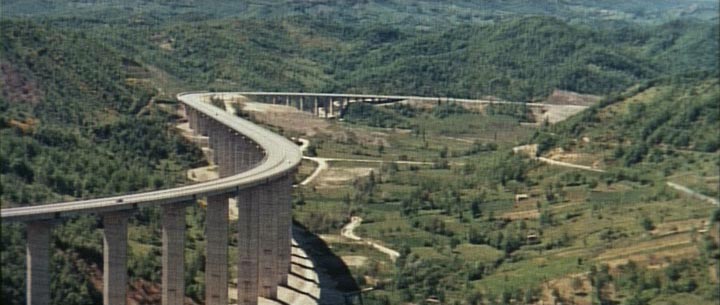
It is a long concrete snake which crawls through a green southern Italian valley, rising above with majesty. A gigantic highway bridge which fluidly carries cars coming from and going to places we will never know of. It is modernity in motion, arrogantly cutting through the past, ignoring those who can't follow its pace.
Down in its shadow, at the foot of the piles, lies a village, stuck in a timewarp. Remote from the movement above.

Two different worlds, living next to each other but completely separated. Yet interactions do occur, and this is the idea Non si sevizia un Paperino (Don't torture a Duckling - Lucio Fulci, 1972) is built on: describing and analysing the violent effects of the intrusion of urbanisation and modernisation in a conservative community.
This is why, contrary to what's being often said, this film is not a rural giallo. Giallo is a quintessentially contemporary and urban genre, and this one is no exception.

In fact, "Non sevizia..." can be considered a detailed report of the reactions of a body rejecting a transplant.

An emblematic symptom of the rejection: Patrizia (Barbara Bouchet). She is the girl who came from the city through the highway, driving a powerful Iso Lele. She lives in a house at the entrance of the village. Her home remains outside of the community though, both geographically and architecturally (a futuristic building in complete contrast with the traditional little white houses). To escape from the suffocating atmosphere of the village which ostracises her, she sometimes goes back to her natural element, the highway, and drives for hours for the sake of driving. Movement against immobility.
She also actively tries to convert the most permeable elements of the community to her libertarian lifestyle, by sexually teasing the young boys of the village.

Temptation is coming from outside. The same teenage boys can't help being intrigued by the regular visit of other outsiders : prostitutes coming from the city to give some nice time to a few workmen.
Temptation is a threat to the community; it jeopardises its future by corrupting youth and detracting them from traditions. It detracts them from the most important: religion.
Temptation implies change, when the main aspiration of this traditional land is to maintain a status quo.

So when the young boys start being murdered one after the other, the whole community stands as one, pointing at those who are considered outsiders: the village idiot, the sleazy city girl Patrizia and a poor mad woman considered a witch, Martiara (Florinda Bolkan).

But the death of the young boys is the brutal and obvious symptom of the village's rejection of the modern world: it's in fact from the deep heart of the community that the sacrifice of "corrupt sprouts" was perpetrated.


Don't Torture a Duckling is probably one of the best gialli ever made, and certainly a demonstration of Lucio Fulci's underestimated talent. It also ties back to the director's obsessions about the body, which he explored in most of his films. More on this theme from this blog here.

Wednesday, May 31, 2006

Films I talked about in March, April & May


Django - Sergio Corbucci - 1966

Tutti i colori del buio (All the Colors of the Dark) - Sergio Martino - 1972

Lo Squartatore di New York (The New York Ripper) - Lucio Fulci - 1982

Quattro mosche di velluto grigio (Four Flies on Grey Velvet) - Dario Argento - 1971


Specific topics
The incompetence of the police in giallo
Futurism and the Italian avant-garde in the early XXth century
The soundtracks of Gianni Ferrio


See also "Films I talked about in February"

Saturday, May 20, 2006

What is the police doing?

Police inspectors at work in Strip Nude for Your Killer.


Institutions falling apart - an underlying topic of Italian genre cinema, especially in Giallo and Poliziesco.

In Giallo, the police is either non-existent, like in Martino/Gastaldi's movies (The Strange Vice of Mrs Wardh, Case of the Scorpion Tail, Your vice is a locked room...), or ridiculously incompetent, like in the caricatural Strip Nude for Your Killer (A. Bianchi - 1975), or even evil and corrupted, like in Aldo Lado's Short Night of the Glass Dolls (1971).
In the best case scenario, it is so inefficient that it needs an outsider's help to do most of the job (like in Dario Argento's animal trilogy).

The figure of the stranger who happens to take the biggest part in the plot's resolution - the "hero by accident", which is already present in the very first giallo La Ragazza che sapeva troppo by Mario Bava - is so recurring that it's like an acknowledgement of a society which has completely lost faith in itself:
Good things can only come from outside of a deeply corrupted community.


More from this blog on Giallo's questioning of Italian institutions here.

Friday, May 05, 2006

Unlighthearted


Usually a cowboy doesn't come without his horse.
Django (Franco Nero in Sergio Corbucci's eponymous film, 1966) doesn't come without his coffin.

Initially, I had decided to watch a spaghetti western as a recreation from Giallo. How naive of me: it's hard to think of a more gothic western than this very dark, very violent, very nihilistic film which epitomises the opposition between the American and Italian Western genres.

Django seems to have been built on a systematic inversion of the classic western codes:
the classic cowboy rides an energetic horse, Django carries a dirty coffin;
the classic landscape is wide open, full of promises, here the decaying city is slowly sinking into the mud (where a bunch of prostitutes are wrestling at some point, offering a typical Meyer-ish scene...);
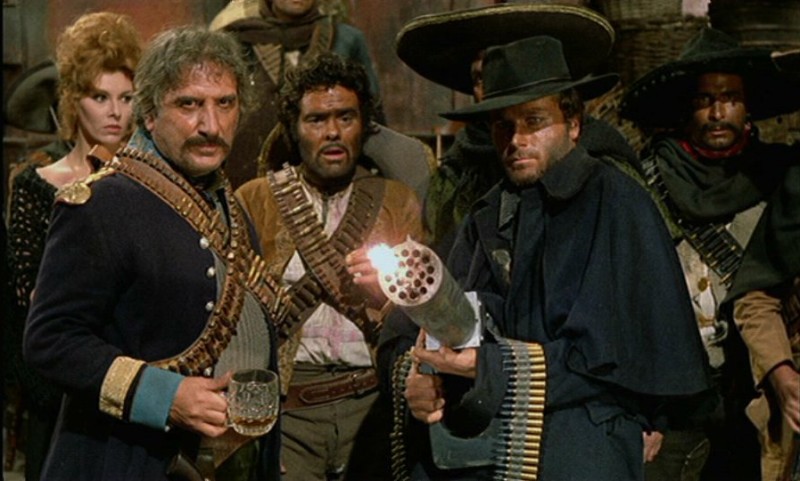
classic gunfights are based on honour and all opponents are equitably armed, when Django's coffin hides the most deadly machine gun which leaves no chance to his enemies and results in massive killings...
The list of examples could go on forever.

When classic western was an epic representation of the American pionneering spirit, overcoming obstacles to get a better life, Django, as one of the funding movies of the Italian western, is its perfect symmetrical embodiement:
a devastated land where Death has blue eyes and carries a coffin.


Django, a strange crossover of a gothic movie, a western and a shoot-them up video game. Available here.

Monday, May 01, 2006

Femme fatale


Among the many actresses who were trying to build their fame in genre cinema, one was sadly under-employed and did not appear in the best productions: Marina Malfatti.
With her beautiful yet strange looks, she's a typical European "femme fatale" of the 70's. Severe but charming, Italian with a hint of German style, mysterious and vulnerable, she probably epitomises ambiguity better than any other.

Her magnetic presence in the role of Mary, Jane's (Edwige Fenech) mysterious neighbour in "All the colors of the dark" (Sergio Martino - 1972), by far makes her the most interesting character in this otherwise particularly disappointing giallo. She manages to exhude a poisonous beauty which perfectly suits her character and makes her very attractive yet scary at the same time. Probably the modern idea of a witch.

In the film, she is the one who leads Jane to a satanic sect, then vanishes. She is Mary, not that immaculate.


If "Tutti i colori del buio" is a giallo you can easily live without, its score by Bruno Nicolai is a great one you can find here.
Marina Malfatti was also quickly appearing in Umberto Lenzi's "Seven Bloodstained Orchids", on which I wrote a few words there.

Monday, April 17, 2006

Like porn


1982. New York has one of the highest criminality rates of the cities of the world. It epitomises more than any other place the modern Babylon.

1982. Giallo's golden years are far behind. In fact the genre has slowly died in the second half of the 70's, clearing the ground for new 'filones' going even further in the visual representation of violence: the most well-known being the zombies and cannibal genres.
The 'after-giallo' Italian cinema is somewhat a desperate and vain race to reach new heights in shocking audiences, against the ineluctable rise of television.

1982. Lucio Fulci's "New York Ripper" is released and soon becomes famous because of the multiple problems the film encounters with censorship boards in most countries.
Nearly 25 years after, this infamous shocker is still widely debated: a masterpiece or a rip-off? a giallo or a slasher? Should the killer have a Donald Duck voice or shouldn't he?

The anti-aesthetical core principle of "The New York Ripper" - the raw photography, the run-down locations, the miserable characters... - makes this film philosophically incompatible with Giallo.
At the same time, the complete absence of any puritanistic or moral subtext which is slasher's trademark doesn't allow to affiliate the film to this typically American genre.

It's hard to classify "the Ripper". It is so cynical and nihilistic it is almost an experimental object.

In fact, it could be compared with porn as it uses a similar parasitic approach: diverting a rather classic and well-coded cinema style to use it to its own advantage. When porn leverages any stereotypical scenaristic frame as a pretext to fit in as many porn scenes as possible, Fulci hijacks the early 80s American cop film codes and structure to stuff it with ultra-violent (and sometimes almost pornographic) sequences.

This method makes the film both very flat and very paroxystic at the same time. Flat because the scenario is incredibly predictable, linear and, at the end of the day, banal as it is a stereotypical American cop movie, of which Fulci has respected all the codes, including the cheesy score. Paroxystic because this banality is meticulously dynamited from the inside by the regular occurence of voyeuristic and disturbing peaks of violence. Hence an overall feeling of heterogeneity.

In its Italian DVD edition, "The Ripper's" bonuses consist in all the murder scenes in their uncut versions. After watching everything, you get this odd feeling that these bonuses, the murder scenes seen in isolation, embody in fact the purest version of the film. They don't need any scenaristic frame around them to work efficiently. They are its 'raison d'être'. As if Fulci, in an afterthought, had been forced to find a scenario to wrap these scenes in order to be able to produce the movie.
Again, just like porn.

That does not solve the question of the killer talking with a Donald Duck voice, a detail considered original by some, grotesque by others. What's for sure is that it is on behalf of Fulci an intentional disrespect for the rules of the American cop movie: killers don't have a ridiculous voice like Donald Duck's. But what if it was an ironic statement on US subculture?

Yes the world can also be terrorised by Disney's creatures.


"Lo squartatore di New York" is widely available in dvd (US/IT/FR) and its 80s funk influenced score can be found here.

Friday, April 07, 2006

Avanti!

Dinamismo di un automobile - Luigi Russolo, 1911


"We affirm that the world’s magnificence has been enriched by a new beauty: the beauty of speed. A racing car whose hood is adorned with great pipes, like serpents of explosive breath—a roaring car that seems to ride on grapeshot is more beautiful than the 'Victory of Samothrace'."

Extract from the "Manifesto of Futurism", Filippo Tommaso Marinetti.
Published in Le Figaro, Paris, 20th of February, 1909.


A few years before the First World War bursted, a group of Italian artists, led by writer Filippo Tommaso Marinetti, founded one of the most important artistic movements of Europe's early XXth century avant-gardes: Futurism.

Celebrating speed and violence, throwing away the past in a strong rupture with Italy's conservatisms, Futurism had the ambition of spreading across all disciplines: writing, painting, sculpture, architecture, music, fashion and obviously embracing recently born cinema as a key art form.

Again the typically Italian dialectic between conservatism and modernity, pushed to violent extremes.
Again the aesthetisation of violence, elevated to an art form.
Of course no obvious links with Giallo, but a similar 'engine' born out of Italian society's tensions and contradictions, which produced many great artistic movements across the last century in this country.


Futurism and other Italian avant-gardes between 1900 and 1950 are explored in the "Italia Nova" exhibition held at Le Grand Palais in Paris, starting April the 5th.
A great web resource on Futurism: futurism.org.uk
.
The Estorick Collection, in London, is also a small yet great museum dedicated to Italian modern art, which has very interesting exhibitions (read a previous post from this blog here).

Tuesday, March 21, 2006

Take a walk with Gianni


Take a walk with Gianni Ferrio.
Or rather, let him take you for a walk throughout the refined paths of his elegant melodies.

Gianni Ferrio is a much less well-known composer than Morricone, especially in Giallo. Yet his music stands for me as the most delightful surprise of the genre's soundtracks.

It's particularly interesting noticing the differences between both musicians in the composition structure.
Morricone builds his scores on a simple and recurring theme, which somehow works like stones thrown on the water's surface: bouncing and developing circles in waves which grow and vanish, always moving back and forth. An almost fractal musical structure, both very tight and loose at the same time, which made his signature and probably produced the most beautiful themes ever written for films.

If Gianni Ferrio does not have this incredible consistency and strength within his own themes, he is definitely immensely talented for something different, very much ahead of its time: coming up with deliciously crafted pop melodies encapsulated in a mix of jazz and classical structure. This cross-over of musical genres is so natural in his compositions that it comes across effortlessly.

La Morte Accarezza a Mezzanotte is a great example: its theme was built on the main character, Valentina, like a pop-sounding starting point of both the film and the score, which later takes us through more jazzy sounds, nice acid jazz party snapshots and eventually easy listening flavours. It really feels like visiting a house: the general atmosphere remains consistent but depending on the moment and the room you're in, the atmosphere changes and you experience a variety of tunes few composers can compete with.

Another fantastic score is Una Farfalla con le Ali Insanguinate, which manages to mix Tchaikovsky's Concerto no.1 with a jazz tune and makes it sound perfectly elegant and balanced. Again this soundtrack feels like taking a nice walk through the park of an old house which classy owners all have something to hide. Not to forget this very melancholic core theme, reflecting the bitter reality behind a glossy surface depicted by the film. One of these scores which is completely tailor-made for the film yet has a life of its own.

Thanks for the nice walks, dear Signore Ferrio.


Gianni Ferrio's giallo soundtracks and more are available at Movie Grooves.

Monday, March 13, 2006

A tragic clown


Humour comes in short supply in Giallo.
Four flies on grey velvet (Dario Argento, 1971) is a notable exception. If the main character, Michael Brandon, is quite a bland figure, secondary casts are an interesting gallery of tragi-comic characters, sad and grotesque in a unique Italian way.
Take Gianni Arrosio, for example.

Played by Jean-Pierre Marielle, one of the finest French actors, Gianni Arrosio is introduced to us as a homosexual private eye who never solved a case in his life.
Even though Argento's vision of homosexuality is highly stereotypical and sometimes falls into a caricature, Marielle manages to turn it into some kind of weirdness which gives Arrosio an amusing bizarreness.

When Tobias, the rock drummer who's blackmailed for a murder he committed by accident, comes to meet him, Arrosio is busy re-painting his office, wearing a ridiculous blouse. Taken in this embarrassing situation clearly showing he's got nothing much to do, he doesn't seem surprised and very naturally puts down his brush to sit back at his desk, ready to listen to his new client.

"After so many failures, the probability of me solving this case has never been so high", he says as an encouraging start for his investigation, leaving Tobias puzzled. From the very start, Marielle makes his character a tragic clown, both funny and desperate at the same time.

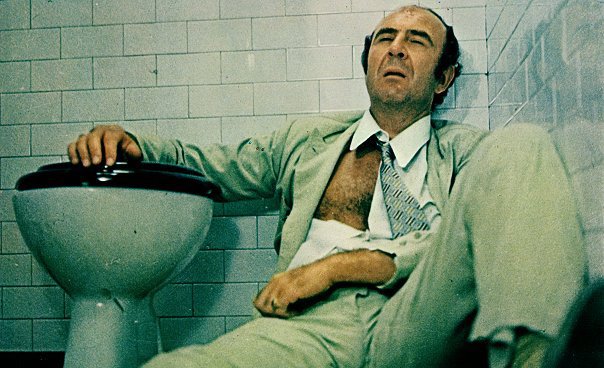
Later in the film, Gianni Arrosio will be the first to identify who's behind the plot. When the blackmailer leads him into a trap in Milan subway's public toilets, and eventually kills him by injecting air through a hypodermic needle in the heart, his last words will be: "I knew I was right". As if he could not believe himself that a success would be possible.

Such an achievement could only condemn him to death.


Jean-Pierre Marielle is an actor whose talent is unique. More about him on Wikipedia in English or in French.

Tuesday, February 28, 2006

Films I talked about in February


Quattro mosche di velluto grigio (Four flies on grey velvet) - 1971 - Dario Argento

Una farfalla con le ali insanguinate (The bloodstained butterfly) - 1971 - Duccio Tessari

L'ultimo treno della notte (Night train murders) - 1975 - Aldo Lado


See also "Films I talked about in January"